ChatGPT, Claude or Gemini in 2026: watch the meter
This article was fully rewritten on 6 September 2026 with the current prices, models and limits.
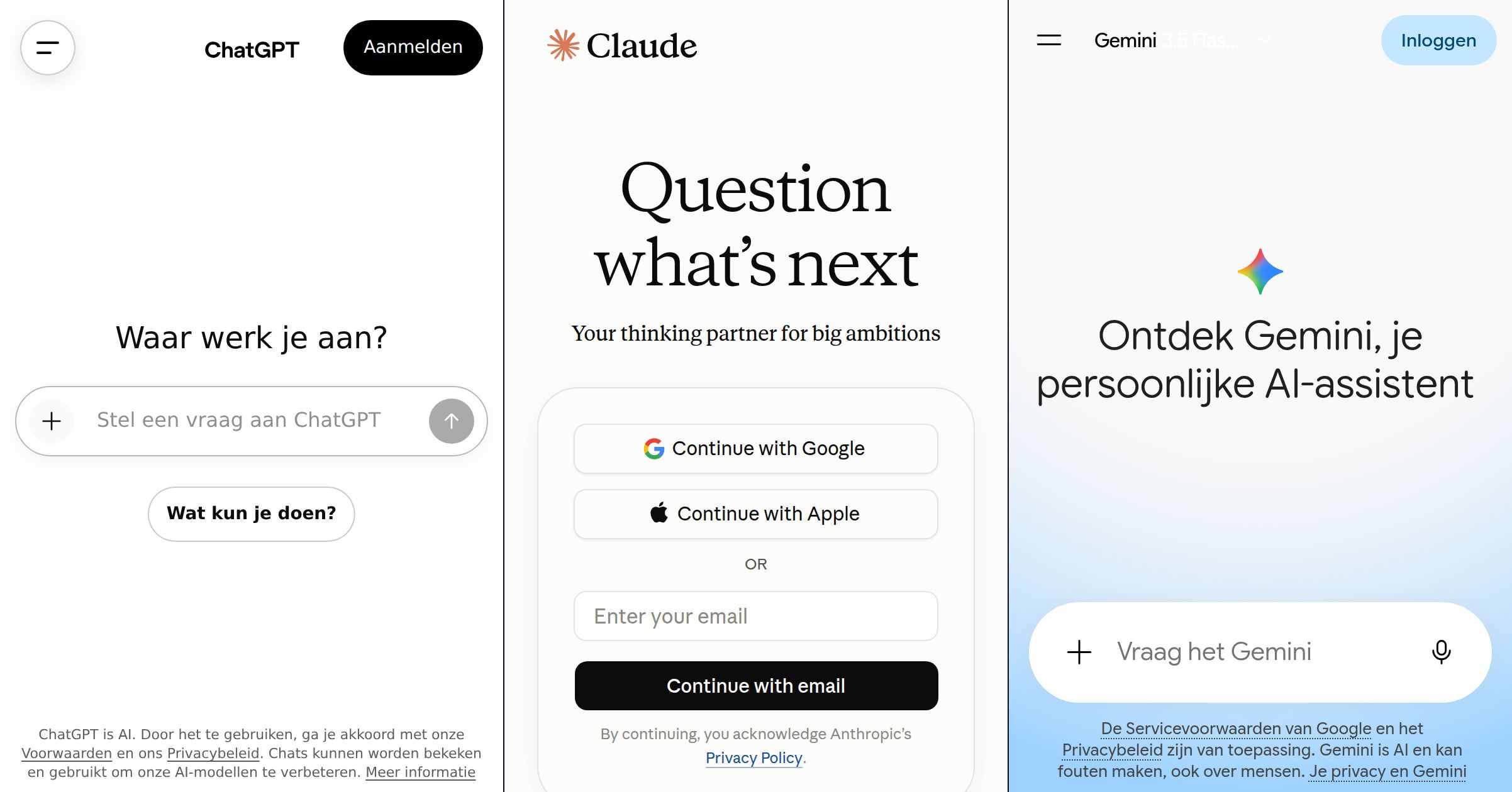
Which of ChatGPT, Claude and Gemini is the smartest? Outside the makers’ own marketing, that is nearly impossible to prove: the three have converged, and every vendor measures in its own favour. What is down in black and white, though: prices and limits. And that is where things have moved fast in 2026. All three are keeping the subscription price stable while tightening the meter. So skip the benchmark scores and compare what a euro buys you in usage.
What the subscriptions cost
The three price ladders look strikingly similar. Amounts are per month, in euros as the official pages showed them on 6 September 2026; they can vary slightly by country, partly due to VAT.
| ChatGPT | Claude | Gemini | |
|---|---|---|---|
| Free | €0 (GPT-5.6 Luna) | €0 (Sonnet and Haiku) | €0 (3.6 Flash, limited 3.1 Pro) |
| Entry | Go, €8 | none | AI Plus, €4.99 |
| Mid-tier | Plus, €23 | Pro, €18 (€15 billed annually) | AI Pro, €21.99 |
| Top | Pro, from €103 | Max, from €90 | AI Ultra, €99.99 to €219.99 |
Sources: the pricing pages of OpenAI, Anthropic and Google, consulted on 6 September 2026.
A few things stand out. Google’s AI Plus is by far the cheapest paid entry at €4.99 (double limits, Gemini inside Gmail, 400 GB of storage). For OpenAI’s Go, meanwhile, the pricing page literally states “This plan may include ads”, and neither Sol nor Astra comes with it. At the top end, Claude Max is narrowly the cheapest flagship tier; Gemini AI Ultra climbs to €219.99, but then bundles Deep Think, over 20 TB of storage and YouTube Premium.
For business, OpenAI and Anthropic both charge in dollars, at exactly the same price points: OpenAI’s Business costs $20 per user per month billed annually or $25 monthly, Business Premium $100 or $125, and Claude Team charges the same amounts for its Standard and Premium seats. Google plays it differently: since early 2025, Gemini has been included in the Workspace subscriptions.
The meter is the real price
What those amounts buy has been measured out more tightly at all three, above all on the top models:
| Plan | Top model | What the meter says |
|---|---|---|
| ChatGPT Plus (€23) | GPT-6 Astra | 5 to 45 messages per 5 hours; on Plus, Astra only in Work and Codex |
| ChatGPT Pro (from €103) | GPT-6 Pro | 50 to 200 messages per week |
| Claude Pro (€18) | Fable 5.1 | not included, only via separate credits |
| Claude Max (from €90) | Fable 5.1 | at most 50% of your weekly limits |
| Gemini AI Pro (€21.99) | Gemini 3.1 Pro | compute limit per 5 hours plus per week |
The figures come from OpenAI’s help article (updated on 6 September 2026), Anthropic’s support page on Fable and Google’s explainer on limits.
The sharpest cut sits with OpenAI. Standard Astra allows roughly half as many messages per five hours as its predecessor GPT-5.6 Sol: 5 to 45 on Plus instead of 10 to 100, The Decoder reported on 5 September 2026, based on OpenAI’s pricing documentation. We wrote earlier about why that amounts to a hidden price rise. The help article adds fine print the pricing page does not show: GPT-6 Pro rolls out only to the Pro, Business and Enterprise plans, and on Plus, Astra lives only in ChatGPT Work and Codex, not in the regular chat. OpenAI is generous on one front: the context window, how much text the model holds in one go: 256,000 tokens on Plus, 400,000 on Pro (reasoning models).
Anthropic rations just as strictly. Fable 5.1, launched on 1 September 2026, may consume at most half of your weekly limits on the Max plans and is not part of the Pro subscription: there, you pay per use with credits. All paid plans combine a five-hour window with a weekly limit; web, desktop, mobile and Claude Code all draw from the same pot. On top of that, Claude Code’s weekly limits drop by a net 17 percent on 14 September, by Anthropic’s own calculation (via BleepingComputer, 29 August 2026). Why that fits the strategy behind Fable 5.1 is in our analysis.
Google switched to compute limits on 17 May 2026: no fixed message count, but a usage meter per five hours plus per week, with heavy features such as Deep Research consuming more of it. After user complaints, Google eased those limits at the end of May and announced pay-as-you-go credits (9to5Google, 28 May 2026). The flagship in the app is Gemini 3.1 Pro; the fast model is 3.6 Flash (release notes).
Three vendors, one move: the invoice stays put, the meter gets tighter, and all three sell or promise separate credits as an overflow valve. What a plan is worth is written in the fine print.
Where each profile ends up
Only chat now and then? Stay free. ChatGPT Free calls text chats “unlimited” within anti-abuse limits, Claude gives you Sonnet and Haiku at no cost, and Gemini offers 3.6 Flash plus limited access to 3.1 Pro and Deep Research. If you want to pay anyway, Google AI Plus at €4.99 is on paper the best-value entry point; ChatGPT Go costs €8 and warns, in its own words, about possible ads.
If you chat daily, you land in the €18 to €23 mid-tier, where comparing is hard: OpenAI counts messages, Google counts compute, Claude counts windows and weekly pots. What is certain: with Astra, OpenAI gave you fewer messages for the same money, and on Claude Pro the top model costs extra. If you keep hitting your ceiling, Claude Max is the cheapest-priced flagship tier, ahead of Gemini AI Ultra and ChatGPT Pro; whether it also gets you the most cannot be deduced from the documentation.
If you work a lot with documents or code, Claude Pro is the cheapest mid-tier plan that ships a terminal tool (Claude Code) and Projects, for €15 to €18; just know those weekly limits fall on 14 September. At OpenAI, the large context window is the argument for Plus or Pro.
If you live inside Google’s apps, this is not a contest: AI Plus or AI Pro puts Gemini in Gmail and the rest of Workspace and bundles 400 GB to 5 TB of storage; the other two include no storage.
For a small team (Business runs from 2 to 200 users), OpenAI and Anthropic cost the same to the dollar. The difference sits at the top: Business Premium literally promises “5x more usage than standard, with no 5-hour limit”, while Claude Enterprise starts at $20 per seat plus usage at API rates. If you already pay for Google Workspace, you already have Gemini. Check how each vendor handles customer data too: the training policies differ mainly between consumer and business accounts; the full story is in our GDPR guide.
That leaves the question of who builds the smartest assistant. The honest answer: these sources cannot settle it, and the numbers shift every few months; this piece needed a complete rewrite after less than ten months, and OpenAI’s AI browser Atlas did not even reach its first birthday. What does hold true: the price of AI is no longer on your invoice, it is on your meter. Look there first.