
Price War: Opus 5.5 and GPT-6 Are Mostly Cheaper
On 22 September 2026, the two largest AI labs released their new models on the same day. Anthropic released Claude Opus 5.5, OpenAI came with GPT-6 Sol and Luna. And if you lay both announcements side by side, you see the real news repeats twice over. Not the benchmarks, but the price list. Both labs promise essentially the same thing: a bit more for a lot less money. The question is what that says about where this race is heading.
Anthropic: top-tier performance at 40% less
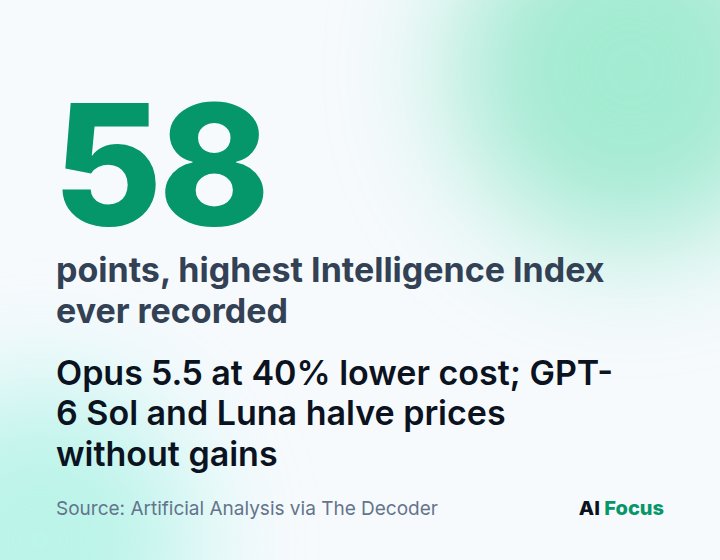
Claude Opus 5.5 costs $4 per million input tokens and $20 per million output tokens, 20% less than Opus 5. Cache reads, re-reading text the model has already processed, drop to $0.20 per million, 60% cheaper. And then there is Anthropic’s own total claim: “It performs at the level of Claude Fable 5.1 on most work and costs 40% less to run than Opus 5.” Three different percentages, then, for three different things: 20% on tokens, 60% on cache, 40% on the total running cost of typical work.
The performance gains are there, though, according to The Decoder’s analysis: 66.4% on Terminal-Bench 4.0, where Fable 5.1 achieved 55.8%, 67.7% on Humanity’s Last Exam with tools, and 58 points on the Artificial Analysis Intelligence Index, the highest ever measured. Anthropic also promises improvement in the formulaic writing style critics dubbed “Claudish”: according to the company, the model puts “the most important information first”, uses less jargon, and follows writing instructions better. Early testers called the output “clearer and easier to understand”.
The safety side remains at Fable 5.1 level: sensitive cybersecurity tasks are routed to Opus 4.8, biology follows the Life Sciences Verification Program, and “preserved thinking” is meant to prevent distillation by competitors. Watermarking to comply with the EU AI Act is included. The model is available immediately on AWS, Google Cloud, Azure, and the Claude Platform, under model ID claude-opus-5-5. Tweakers also picked up the release, with the price drop as the headline. Rightly so.
OpenAI: half price, same intelligence
OpenAI replaced GPT-5.6 Sol and Luna with GPT-6 Sol and Luna on the same day, and there the message is even blunter: prices halve, scores do not. Sol drops from $4/$20 to $2/$10 per million tokens, Luna from $0.20/$1.20 to $0.10/$0.50. The Decoder lined up the benchmarks and summed up the Artificial Analysis figures like this:
“GPT-6 Sol and Luna cut per-task costs in half compared to their predecessors, but intelligence scores stay at GPT-5.6 levels, with gains in some evaluations and regressions in others.”
In other words: GPT-6 Sol and Luna cut the cost per task in half compared to their predecessors, but intelligence scores remain at GPT-5.6 levels, with gains in some evaluations and regressions in others. Concretely, Sol moves from 47 to 48 points, one point ahead, while Luna stays flat at 37. On the GDPval benchmarks for knowledge work, there are even regressions.
The positioning is clear: Sol for complex recurring tasks like code review, debugging, and analysis; Luna for high volume and bounded work. But there is a curious wrinkle, because Luna at maximum effort matches Sol on “xhigh” and costs 78% less. OpenAI cannibalizes its own more expensive model. The new models sit in ChatGPT Work and Codex for paying subscribers and in the API as gpt-6-sol and gpt-6-luna; free users get Luna on desktop. TechCrunch covered the launch.
The new price list at a glance
All figures per million tokens, old price in parentheses:
| Model | Input per Mtok | Output per Mtok | Change |
|---|---|---|---|
| Claude Opus 5.5 | $4 (was $5) | $20 (was $25) | tokens 20% cheaper, total cost according to Anthropic 40% lower |
| GPT-6 Sol | $2 (was $4) | $10 (was $20) | cut in half |
| GPT-6 Luna | $0.10 (was $0.20) | $0.50 (was $1.20) | cut in half, output even a bit more than halved |
The weapon is no longer smarts, but price
Put the two releases side by side and you see where competition is shifting: from “who is smartest” to “who is cheapest per task”. OpenAI halves its prices without meaningful intelligence gains. Anthropic cuts top-tier cost by forty percent. That is no coincidence, that is the same move from two directions, and it echoes the previous price shift with Fable 5.1, where the real news was also in the price list. The pattern repeats.
For users and businesses this is simply good news: the same computation gets cheaper every few months. But two things deserve your attention. One: the fine print per task. OpenAI has regressions on knowledge-work benchmarks, so anyone deploying GPT-6 for exactly that kind of work may net out worse. At Anthropic, sensitive cyber tasks are routed to Opus 4.8, which for that niche means you do not always get the new model that appears on the invoice. Two: that price is now the weapon suggests pure capability leaps are getting rarer, or deliberately held back. Last week Anthropic published measurements that verify its own pace; days later, the sales pitch is not a leap but a discount. Those two facts fit together too neatly.
In practice: if you chose an AI subscription or API budget before this week, you should run your numbers again. How to run those numbers properly, with the actual cost and not the sticker price as your starting point, we laid out earlier in what AI really costs a business. The figures in that piece have been on the favorable side of outdated since yesterday. That is exactly the point.