GPT-6.1 Sol or Sonnet 5.5: same price, which one to pick?
Two middle models, one day apart, exactly the same price tag.
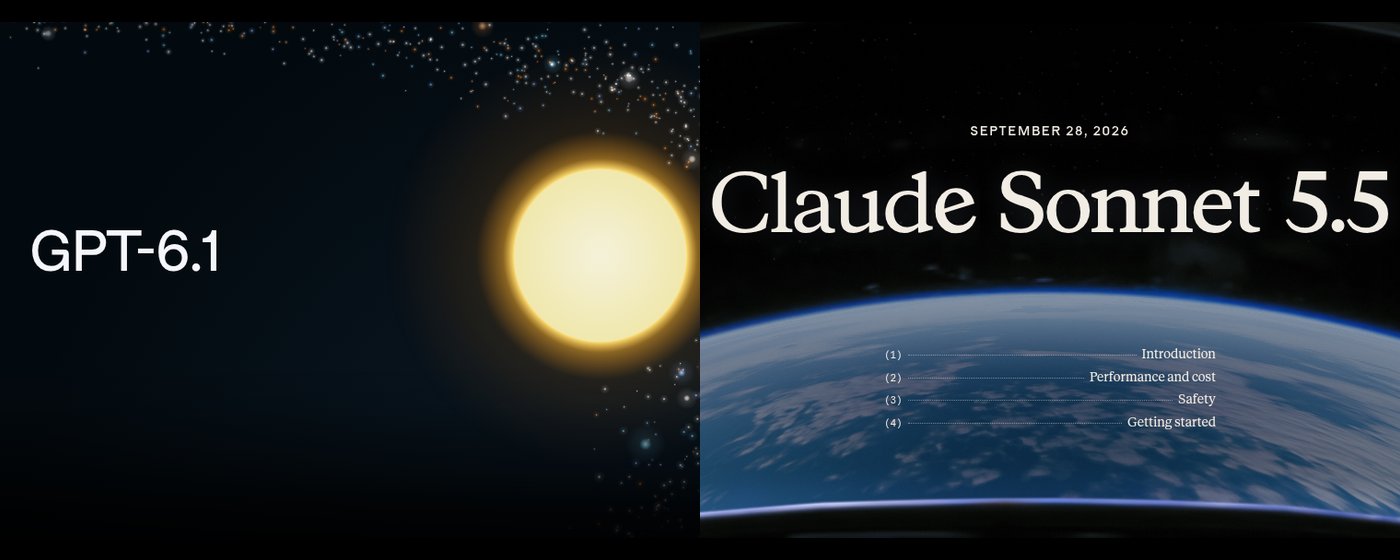
On 28 September 2026, Anthropic launched Claude Sonnet 5.5. A day later, at DevDay, OpenAI put GPT-6.1 Sol on the market. Both cost $2 per million input tokens and $10 per million output tokens via the API.
That does not make the choice any easier. So we looked into what does differ: where you get them, what they actually cost and where their makers say they shine.
GPT-6.1 Sol and Sonnet 5.5 head to head
Both companies work with a ladder of models. At Anthropic, Sonnet sits between the heavy Opus and the light Haiku. At OpenAI, Sol sits between the top model Astra and the cheap Luna.
GPT-6.1 Sol is an upgrade of GPT-6 Sol, which only came out on 22 September. OpenAI promises it “nearly matches GPT‑6 Astra’s intelligence on agentic coding, computer use, and professional work”, at a fifth of Astra’s token price. Astra costs $10 in and $50 out via the API, per OpenAI’s pricing page.
Anthropic, for its part, calls Sonnet 5.5 “a faster, lower-cost complement to Claude Opus 5.5”, strong at well-defined everyday work: fixing bugs, making documents, slides and spreadsheets.
| GPT-6.1 Sol | Claude Sonnet 5.5 | |
|---|---|---|
| Released | 29 September 2026 | 28 September 2026 |
| API: input / output per million tokens | $2 / $10 | $2 / $10 |
| Cache reread (per million) | $0.10 | $0.20 |
| Cache write (per million) | $2.50 | $2.50 (held 5 minutes) |
| Context window | 1,050,000 tokens | 1 million tokens |
| Long queries | above 272,000 input tokens: input and cache 2x, output 1.5x, for the whole query | full window at standard rate |
| In the app | Plus, Pro, Business, Enterprise, Edu: in ChatGPT Work and Codex, not Chat | everyone on Claude.ai, including free |
| Strengths, per the maker | agentic programming, computer use, professional work with PDFs and workflows | well-defined everyday work, bugs, documents, slides and spreadsheets |
Sources: GPT-6.1 Sol announcement, OpenAI’s model page and pricing page, OpenAI’s help article on Work and Codex, Sonnet 5.5 announcement, Anthropic’s Sonnet page, claude.com/pricing and Anthropic’s pricing docs, checked 30 September 2026.
Where you get them: free, subscription or API?
Here the two are furthest apart.
Sonnet 5.5 is the model for everyone. On its Sonnet page, Anthropic writes: “Anyone can chat with Claude using Sonnet 5.5 on Claude.ai, available on web, iOS, and Android.” A free account is all you need.
GPT-6.1 Sol comes with conditions. OpenAI writes: “GPT‑6.1 Sol is available starting today to all Plus, Pro, Business, Enterprise, and Edu users in ChatGPT Work and Codex. GPT‑6.1 Sol is not yet available in Chat.”
What is that distinction? Per OpenAI’s help centre, ChatGPT now has two parts. Chat is for quick conversations and everyday questions. Work is an agent for longer, multi-step tasks that delivers a finished document, spreadsheet, presentation or report. Codex stays the environment for programming work.
OpenAI mentions only paid plans; Free and Go are not listed as getting GPT-6.1 Sol. Nor is there a fixed date for everyone: the model “is rolling out”, and whether you see it depends on your plan, your workspace and the rollout, per the help centre. So if you are on Plus and simply open a chat, you are not talking to GPT-6.1 Sol.
Via the API, both are available right now: gpt-6.1-sol at OpenAI, claude-sonnet-5-5 at Anthropic. Sonnet also runs on AWS, Google Cloud and Microsoft Azure.
What a Plus or Pro subscription costs at each of the three big providers, with Belgian VAT, is in our comparison of ChatGPT, Claude and Gemini.
GPT-6.1 Sol price versus Sonnet 5.5: what do you actually pay?
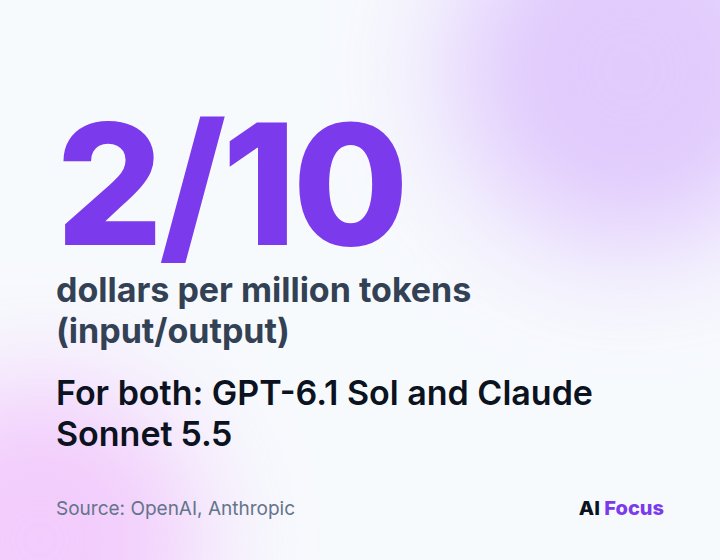
The sticker price is the same. The bill is not always.
Caching. If you send the same long instruction or document each time, that text goes into the cache: a buffer that lets you reread it more cheaply. On Sol that costs $0.10 per million tokens, on Sonnet 5.5 $0.20. A worked example: a chatbot that rereads a 50,000-token manual ten thousand times burns 500 million cached tokens. That is $50 on Sol and $100 on Sonnet, regardless of the rest of the bill.
Long queries. On Sol, a query of more than 272,000 input tokens is billed in full at double the input and cache rate and 1.5 times the output rate. Anthropic bills Sonnet 5.5’s full 1-million-token window at standard rate: “A 900k-token request is billed at the same per-token rate as a 9k-token request.” So if you work with huge files, the advantage swings to Sonnet.
Tokens per task. This is the most uncertain factor. A model that “thinks” less for the same result is cheaper, even at the same token rate. Anthropic says Sonnet 5.5 costs up to 30% less per task than Sonnet 5. OpenAI says GPT-6.1 Sol scores 2.2 percentage points higher than Opus 5.5 on AutomationBench at medium reasoning effort, at about a third of the cost. But Opus 5.5 already costs twice as much per token as Sonnet, so that says little about Sonnet 5.5. We have not yet seen an independent measurement of both models on the same tasks.
Is GPT-6.1 Sol better than Sonnet 5.5? That is impossible to say
Both makers publish a long list of benchmarks, but hardly any overlap.
OpenAI shows DeepSWE, GDP.pdf, AutomationBench, OSWorld 2.0 and Terminal-Bench Science. Anthropic shows Terminal-Bench 4.0, FrontierCode, CursorBench, GDPval-AA, AA-Briefcase and OSWorld 2.1 among others. Only OSWorld appears in both, and even then in different versions: 2.0 at OpenAI, 2.1 at Anthropic.
Also telling is who they measure themselves against. OpenAI does not pit GPT-6.1 Sol against Sonnet 5.5 but against Opus 5.5, Anthropic’s pricier top model. On GDP.pdf, questions on complex PDFs, Sol scores higher than Opus 5.5, according to OpenAI, at less than half the cost per task. Anthropic, in turn, compares Sonnet 5.5 with GPT-6 Sol, the predecessor that got a successor just a day later, and on Terminal-Bench even to the older GPT-5.6 Sol.
So both pick an opponent that suits them. Only the things in the table are comparable: price, cache, context window and availability.
Sonnet 5.5 or GPT-6.1 Sol: which one to pick?
Pick Sonnet 5.5 if you:
- want to use Claude free or in regular chat;
- work with very long documents, above 272,000 tokens per query;
- do bounded jobs: rewriting text, hunting a bug, putting together slides or formatting a spreadsheet.
Pick GPT-6.1 Sol if you:
- already have Plus or Pro and work in ChatGPT Work or Codex;
- build an app that reuses the same context over and over, because then that half-price cache adds up;
- build your own agents that read PDFs or carry out business processes, where OpenAI posts its strongest scores.
Unsure as a developer? Let both run for a week on your own tasks and compare the bill per task, not per token. That is the only comparison that counts for you.
Our take: $2 and $10 is the new standard
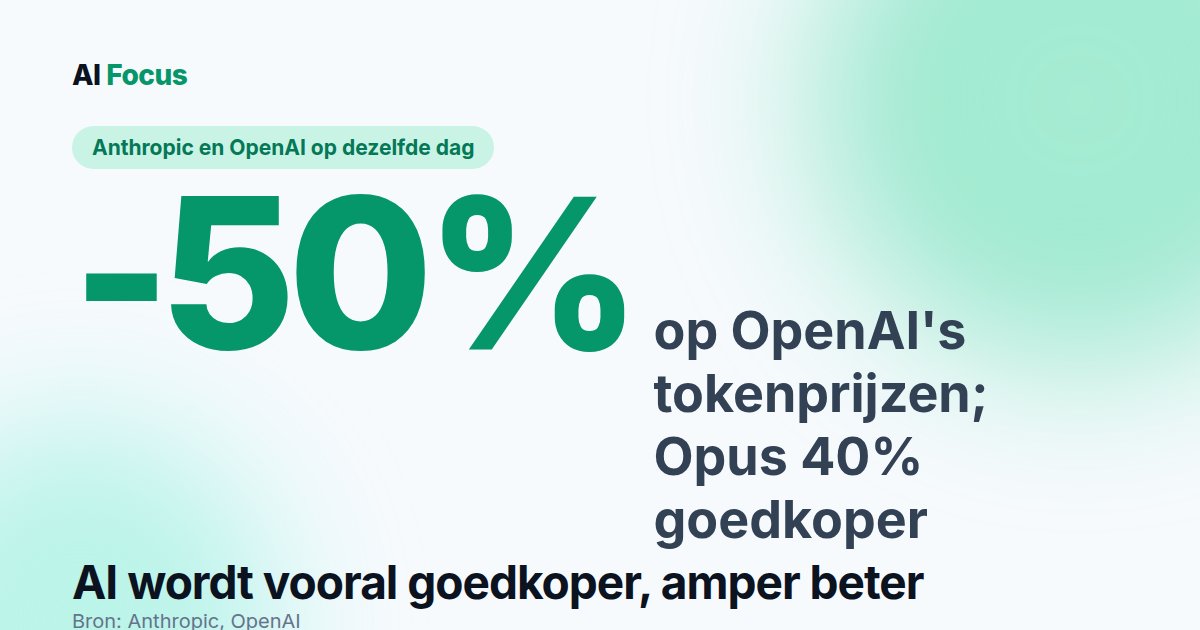
That the two new middle models cost exactly the same is no accident. Sonnet has cost $2 and $10 since Sonnet 5. OpenAI halved Sol on 22 September from $4/20 to $2/10, and is now keeping that price for a stronger model. The middle tier now has a fixed price, and the fight shifts to what you get for that price: fewer tokens per task, cheaper cache, a longer window.
The strongest counterargument: for developers with lots of repeated context, half-price caching is no detail, and OpenAI clearly wins there. True. But that is a calculation for someone building an app.
For most people in Belgium who just take a subscription, the API price plays no role. What counts is where you get the model in the app. And there the gap is wide: you get Sonnet 5.5 free in every chat, GPT-6.1 Sol only paid and only in Work and Codex. If you mostly use ChatGPT to chat, you will not notice GPT-6.1 Sol for now.