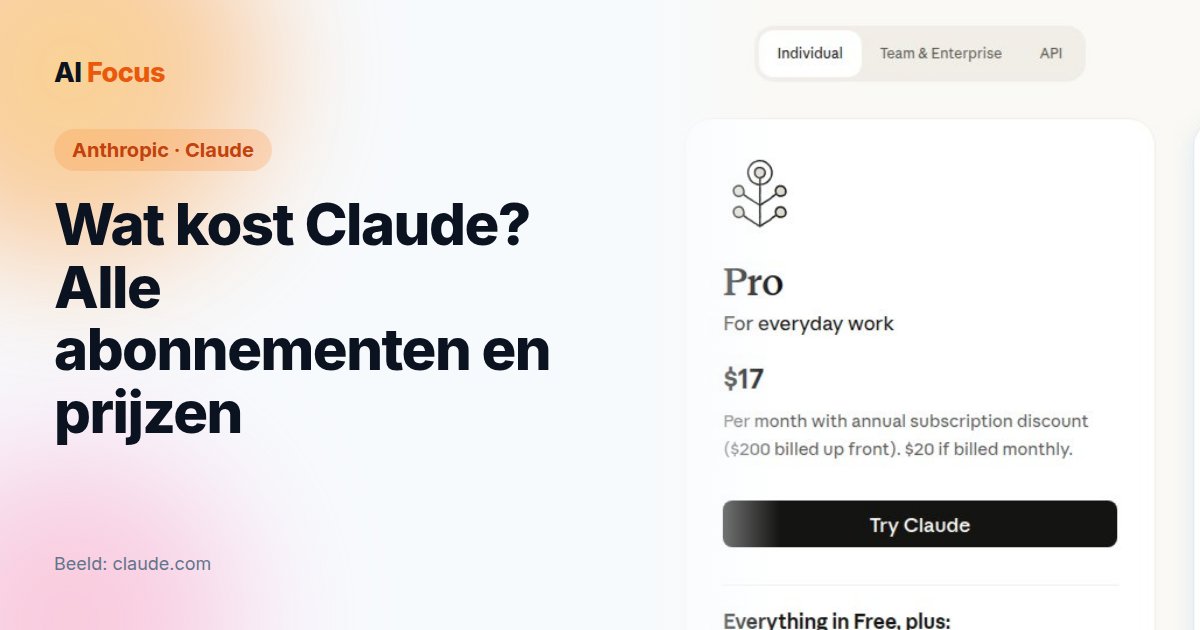
How much does Claude cost? All plans and prices (2026)
Claude costs nothing if you only use it now and then, $20 a month for Pro, and $100 or $200 a month for Max. In Belgium, add 21% VAT, because Anthropic shows prices without tax.
That is the short answer. The longer one covers what you get for that money, because with Claude the price per month is only half the story. The other half is the meter: how much you can use before you have to wait.
We lay it all out, straight from claude.com/pricing and Anthropic’s help centre, checked on 2 October 2026 and updated on 8 October 2026.
All Claude subscriptions at a glance
| Plan | Price per month (excl. VAT) | Models | Usage according to Anthropic | Claude Code |
|---|---|---|---|---|
| Free | $0 | Sonnet and Haiku | ”Free covers everyday questions” | no |
| Pro | $20 monthly, or $17 billed annually ($200 upfront) | Sonnet, Haiku, Opus; Fable only via usage credits | ”at least 5x more usage per 5-hour session than Free” | yes |
| Max 5x | $100, monthly only | everything from Pro, Fable up to 50% of your weekly limits | 5x the usage of Pro per five-hour session | yes |
| Max 20x | $200, monthly only | same | 20x the usage of Pro per five-hour session | yes |
| Team Standard | $20 per seat billed annually, $25 monthly | Sonnet, Haiku, Opus; Fable only via usage credits | ”more usage than Pro” | yes |
| Team Premium | $100 per seat billed annually, $125 monthly | same, plus Fable up to 50% of weekly limits | ”5x more usage than standard seats” | yes |
| Enterprise | $20 per seat billed annually, plus usage at API rates | all models, including Fable | no fixed meter: your usage determines the bill | yes |
Sources: claude.com/pricing, What is the Max plan? for Max 5x and Max 20x pricing, and Claude Fable models on your plan, checked on 2 October 2026.
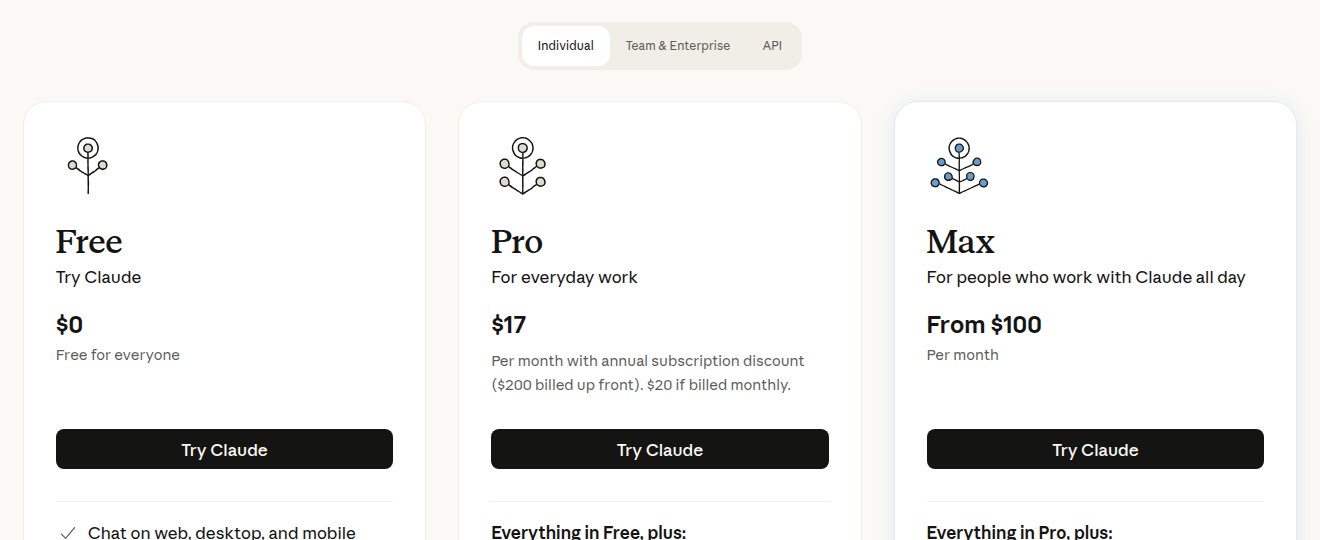
Why dollars? Anthropic prices in dollars and shows local prices only where it supports them. According to the help centre, the price varies by region, and in some countries the tax is already included in the price shown, while in others it is added at checkout. So you only see the exact amount in euros on claude.ai/upgrade or at checkout.
And the free plan is stronger than you might think. On its Sonnet page, Anthropic says: “Anyone can chat with Claude using Sonnet 5.5 on Claude.ai.” Web search, file creation, memory, and up to five Projects are included.
How much does Claude Pro cost?
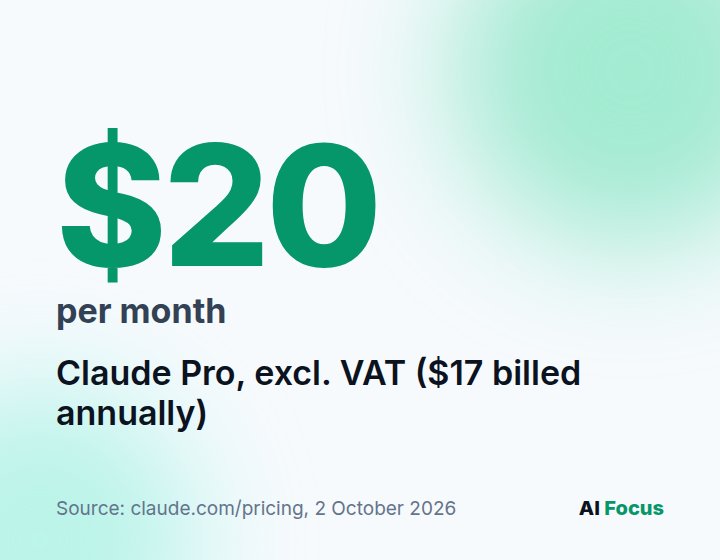
Pro costs $20 a month if you pay monthly. Choose annual billing and you pay $200 upfront, which Anthropic rounds to “$17” per month. With 21% Belgian VAT that becomes $24.20 a month, or $242 per year.
For that you get at least five times as much usage per session as Free, Opus 5.5 for heavier thinking, Research, Claude Code and Projects without the five-project cap. Fable 5.1, the most expensive model, is not included: you pay for that separately on Pro via usage credits.
A Pro subscription also gives you no API credit. According to Anthropic’s help centre, you always pay for API usage separately via the Claude Console.
How much does Claude Max cost?
Max has two tiers: Max 5x costs $100 a month, Max 20x $200. The pricing page itself only shows “From $100”; the two amounts are in the help article on Max. With VAT that comes to $121 or $242 a month.
Max is monthly only; annual billing is only available with Pro and Team. You get five or twenty times the usage of Pro per five-hour session, higher output limits, priority when things are busy, and you may spend up to half your weekly limits on Fable 5.1. Anthropic literally calls Max the plan “for people who work with Claude all day”. New: on 7 October, Anthropic announced that it will roll out a monthly API credit “this week” for Max and Team, usable on the Claude Platform: $100 with Max 5x, $200 with Max 20x, and up to $500 with Team, shared across users. Pro is not mentioned, and the credit had not yet appeared on claude.com/pricing as of 8 October.
If you switch from an annual Pro subscription to Max and your remaining Pro balance is larger than the Max price, you get that balance as a credit on your account, provided your billing address stays the same.
Which plan fits you
You chat now and then. Rewriting an email, looking something up, summarizing a text: stay free. You get the same Sonnet 5.5 as paying users, just with less room.
You work with it every day. Then Pro is the logical step, and with annual billing the price drops from $20 to $17 a month.
You code with Claude Code. Claude Code is in every paid plan but draws from the same pot as your chats. For someone using it a few hours a week, Pro is enough. If you are in it for hours every day, you will quickly hit the limit, and Max 5x is more realistic. Built a website that way? Our guide shows you how to get your AI site online with Netlify.
You are a team in a small business. Look at Team, for 2 to 150 people, mixing Standard and Premium seats. You get central billing, single sign-on and, importantly, Anthropic does not train on your content by default (“None by default”). With Free, Pro and Max you have to opt out yourself (“Opt-out”). Enterprise is always billed annually. If you are a startup, you might get Team free for a year: here is how to apply for Claude Startups. What AI costs a business in total, with training and data risk included, you can read in our cost analysis for businesses.
Claude API pricing
If you build your own app on Claude, you do not pay per month but per token: the small chunks of text that AI usage is billed in. Prices in dollars per million tokens:
| Model | Input | Output | Cache write (5 min) | Cache read |
|---|---|---|---|---|
| Fable 5.1 | $10 | $50 | $12.50 | $0.25 |
| Opus 5.5 | $4 | $20 | $5 | $0.20 |
| Sonnet 5.5 | $2 | $10 | $2.50 | $0.10 |
| Haiku 5.5 (prompt up to 100,000 tokens) | $0.10 | $0.50 | $0.125 | $0.01 |
| Haiku 5.5 (prompt above 100,000 tokens) | $0.50 | $2.50 | $0.625 | $0.05 |
| Haiku 4.5 (previous generation, still on the price list) | $1 | $5 | $1.25 | $0.10 |
Source: Anthropic’s pricing documentation and claude.com/pricing, checked on 8 October 2026.
A cache read means feeding the model text it has already processed, such as a long instruction you send with every question. With the Batch API, for work that does not need to be done right away, you pay half. With the recent models, the full context window of 1 million tokens costs the same per token as a short question. Haiku 5.5 is the exception: above 100,000 tokens you pay five times more per token.
What changed recently
On 22 September 2026, Opus 5.5 came out, at $4 and $20 per million tokens. Opus 5 cost $5 and $25. On 28 September came Claude Sonnet 5.5, at the same token price as Sonnet 5 but according to Anthropic “up to 30% less per task”, because it uses fewer tokens. A day later, OpenAI released GPT-6.1 Sol at exactly the same price.
On 7 October, Claude Haiku 5.5 came out, at $0.10 input and $0.50 output per million tokens for prompts up to 100,000 tokens. According to Anthropic, that is 90% cheaper than Haiku 4.5, and 50% cheaper for longer prompts. On average it costs “around 75% less to run”, in part because Haiku 5.5’s new tokenizer counts slightly more tokens per task. In the Claude apps you can pick it on every plan, from Free to Enterprise. The same day, Anthropic cut the price of cache reads on Sonnet 5.5 in half, to $0.10.
Earlier, on 1 September, Anthropic made caching on Fable 5.1 75% cheaper. On 14 September, by contrast, Claude Code users got less room: “Compared to today, this works out to a 17% reduction in weekly limits on Claude Code”, according to Anthropic, as BleepingComputer noted. Our Fable analysis explains why those two moves are linked.
New usage rules also take effect on 12 November; here is what you can no longer do with Claude.
Hidden costs and pitfalls
The VAT. On claude.com, each plan says: “Prices shown don’t include applicable tax.” So add 21%. If you sign up as a business, you can add your VAT number on Pro and Max once your address qualifies; how you handle the VAT is best discussed with your accountant.
The limits. There is no fixed message count. Each plan has a five-hour window that keeps resetting, and paid plans have a weekly limit on top. How much you can do depends on “the length and complexity of your conversations, the model you choose, and the features you use”. Long chats, large files, Opus and Research eat faster. Anthropic also reserves the right to set “weekly and monthly caps”.
Usage credits. If you hit your ceiling on a paid plan, you can keep working with usage credits. You pay those upfront, on top of your subscription, at normal API rates. Set a monthly cap, because you can also “Set to unlimited”; the only hard cap is a daily limit of $2,000. On Pro it is also the only way to use Fable 5.1, and Fable is the most expensive model.
Annual billing. $17 instead of $20 a month sounds good, but you pay $200 upfront. In the EU you can ask for a refund within 14 days of purchase via your settings, pro rata to what you have already used; after that, payments are generally non-refundable. Unsure? Start monthly: you can always switch to annual, and the unused time on your monthly plan is credited.
Via the app store. The prices apply to a subscription via the website. According to the help centre, the price via the iPhone or Android app may differ.
Our take
Claude is not more expensive or cheaper than the competition: with VAT, Pro sits in the same price range as ChatGPT Plus or Gemini AI Pro. How they stack up is covered in our comparison of ChatGPT, Claude and Gemini.
What sets Claude apart: the free plan gets the newest middle model. So you do not pay for Pro to get a smarter answer to an ordinary question, but for headroom, Opus 5.5 and Claude Code.
The strongest argument against Claude as a subscription is the unpredictable meter. You never know exactly how much you get, and Anthropic showed in September that it can make a net cut to Claude Code’s weekly limits while keeping the price the same.
Our advice: use Claude free for a week. If you hit the limit or miss Opus, switch to Pro, paid monthly. Only move to Max if you run out of room every day with Pro. And at every step, factor in VAT: $24.20 instead of $20.