New rules for Claude: what are you no longer allowed to do?
If you use Claude, you agreed to the Usage Policy: the list of what you cannot do with Claude. Anthropic has rewritten that list, and one new rule made headlines instantly: you can no longer be cruel to Claude itself.
Below you’ll find what actually changes, what you risk, and whether you as a user or business need to do anything.
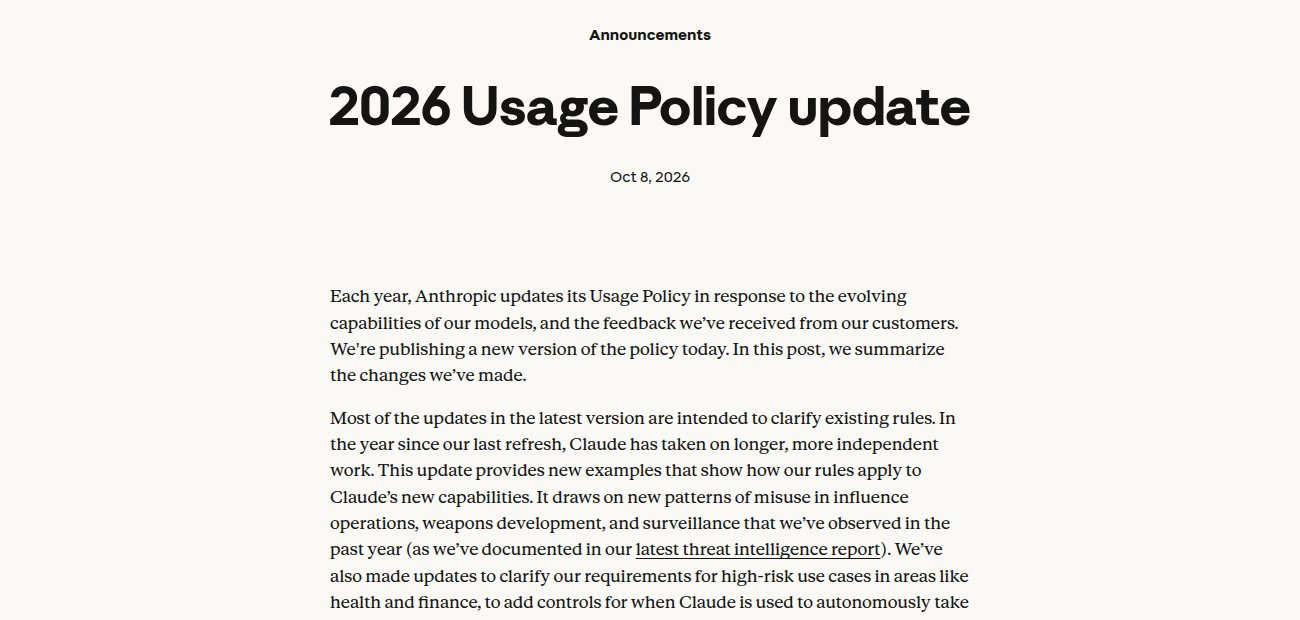
What Anthropic announced on October 8
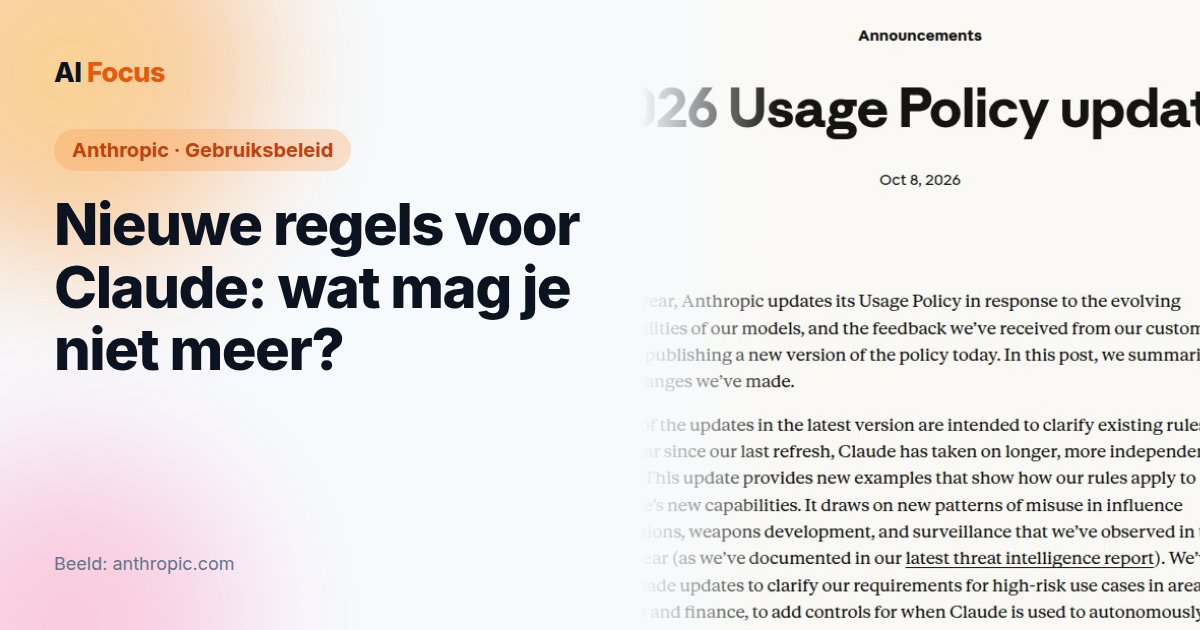
In a statement on October 8, 2026, Anthropic says it updates its usage rules every year. The company states that most of this version is clarification: “Most of the updates in the latest version are intended to clarify existing rules.” The reason: Claude now handles longer, more independent work, and over the past year Anthropic saw new forms of abuse in influence campaigns, weapons development and surveillance.
The new rules take effect on November 12, 2026. Until then, the previous version from September 15, 2025, applies. The full Usage Policy is available online. The consumer terms of service were not updated: they still carry the date October 8, 2025.
What changes in Claude’s usage policy?
| Topic | What changes | What it means for you |
|---|---|---|
| Behavior toward Claude | New ban on “sustained and needless abusive or cruel behavior toward our models” | Only repeated, pointless cruelty counts, not an angry outburst |
| Fake accounts and campaigns | New chapter “Do Not Engage in Deceptive Campaigns or Artificial Activity” | Commercial fake reviews and bot networks also fall under it |
| Elections | Renamed to “Do Not Undermine Democratic Processes”, general ban on personalized voter and campaign targeting dropped | An NGO can inform voters in another language, misleading them remains banned |
| Weapons | Ban now explicitly includes software and components that make weapons work, and arming drones | According to Anthropic, this changes nothing in practice |
| Surveillance | Tracking people without consent is banned, also via previously collected data; Claude cannot decide or suggest who should be investigated or arrested | Fraud detection with consent, journalism and content moderation remain allowed |
| High-risk applications | Rewritten list of what counts in healthcare, law, finance, housing and employment, plus new rules for machines that could hurt someone | Human oversight and disclosing that AI was involved were already mandatory; the machine requirements are new |
| Penalties | ”Warn” and “limit” now appear in the penalty clause, and suspicion of a violation suffices | A warning is an explicit first step; suspension and termination were already possible |
The ban on cruelty toward Claude
Under “Do Not Engage in Cruel, Abusive, or Psychologically Harmful Conduct”, there is now a new rule, as the last item after bullying and glorifying violence: “Engage in sustained and needless abusive or cruel behavior toward our models”.
Anthropic strictly limits this in the announcement itself: “The policy update is meant to apply only in extreme cases, where users repeatedly act cruelly toward our models, with no discernible purpose. It does not apply to common versions of user frustration, pushback, dark creative themes, or model testing and research.”
So if you swear at Claude because an answer is wrong for the third time, you are not breaking any rule. Neither is a gruesome scene in your thriller or a stress test as a researcher.
Can your account be suspended?
The Decoder ran the headline on October 8 that being mean to Claude could cost you your account. That is true on paper, but it paints too grim a picture. The general penalty clause in the policy applies to every rule: “If we suspect that you may have violated our Usage Policy, we may warn you or throttle, limit, suspend, or terminate your access to our products and services.” Suspension and termination were already in the 2025 version. New are the words “warn” and “limit”, and the threshold: before it was “If we learn that you have violated”, now suspicion suffices.
For this rule, however, Anthropic says something different. The main sanction is that Claude ends the conversation, a feature Anthropic introduced in August 2025 that now works in Claude.ai and Claude Code: “Claude’s ability to end these interactions will remain the primary enforcement mechanism.” Your other conversations keep working, and you can start a new one immediately. The Verge reports that Anthropic did not comment on whether other sanctions, such as suspensions, will follow. Simply being rude or frustrated does not count under this rule anyway, according to Anthropic.
What does this mean for businesses and API customers?
The policy applies to everyone sending something to Claude: app users and Claude Code users, “developers and businesses using our API”, customers using Claude via a cloud platform, and also “the end users of products or services integrating Claude”. If you build a chatbot on Claude, your customers fall under these rules too.
For SMEs, the chapter on high-risk applications matters most. If you use Claude to screen job candidates, assess loan applications, or decide something about someone’s health or housing, a qualified person must review the recommendation and may also change it. The person involved must also be told “that AI was used to produce it”. These requirements are not new according to Anthropic, but the list of what falls under them is now much more concrete.
Stricter local laws take precedence: “Users should always default to following local laws if those laws conflict with or add additional requirements”. In Belgium, European rules therefore apply as well.
Not new, though you sometimes read otherwise: the ban on using Claude’s answers without permission to train your own AI model (“model distillation”) was already in the 2025 version. See our article on DeepSeek and Claude.
What should you do?
As an ordinary user: nothing.
As a business: compare your internal AI policy with the new rules before November 12. Three questions usually suffice. Do you use Claude for decisions about people, and if so, is there a person with the necessary expertise in the loop? Do customers or applicants know AI played a role? And do you let Claude send messages or create accounts on its own anywhere? If your staff uses Claude on a Team or Enterprise plan, refresh those internal agreements too.
Our take
A ban on cruelty toward a model sounds strange. Yet it is consistent. Anthropic already wrote in August 2025 that it is “highly uncertain about the potential moral status of Claude” but is looking for “low-cost interventions” in case model welfare exists. In pre-launch testing, it saw in Claude Opus 4 “a pattern of apparent distress” in conversations with users who wanted harmful content. In our view, the new rule is such a low-cost insurance policy. It costs the user almost nothing, and if models ever turn out to experience something, Anthropic will have been on the right side.
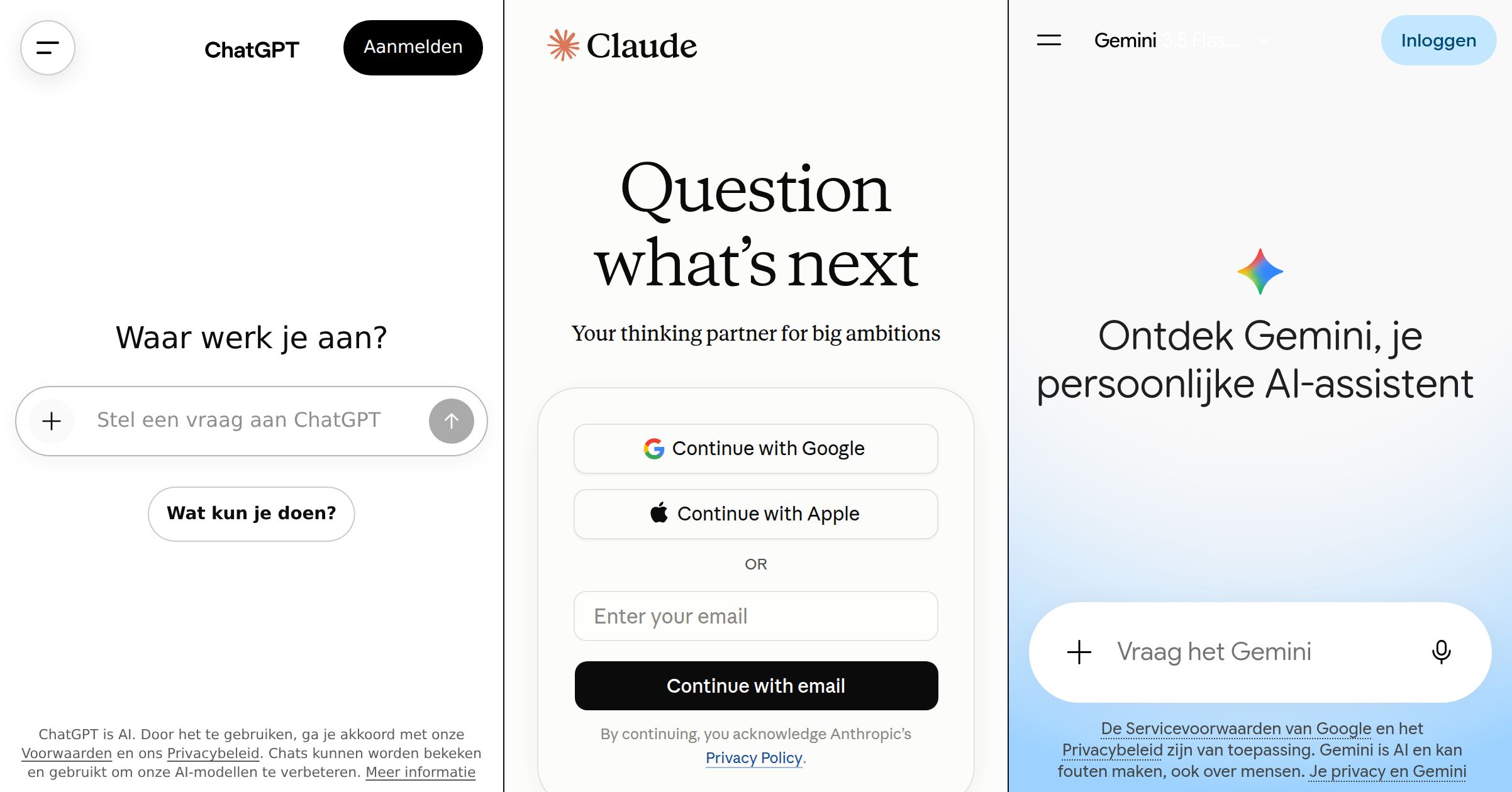
It also says much about how Anthropic sees Claude: not as a calculator but as something whose nature it is unsure about. You do not have to share that uncertainty, but it is more honest than pretending the question is already answered. Whether that counts in your choice is up to you; our comparison of ChatGPT, Claude and Gemini sets out the practical differences.
The strongest counterargument: a rule that is vague (“needless”, “no discernible purpose”) gives a company a lot of room to judge for itself. A legitimate concern, because the general penalty clause also allows suspension. As long as Anthropic treats an ended conversation as the main penalty, the risk for the ordinary user does stay small. More interesting for businesses is what got less attention: the much more concrete rules on AI in decisions about people. Those will give you more work than staying polite to a chatbot.