

Meta’s AI Caller Muse Is Partly a Human Call Center
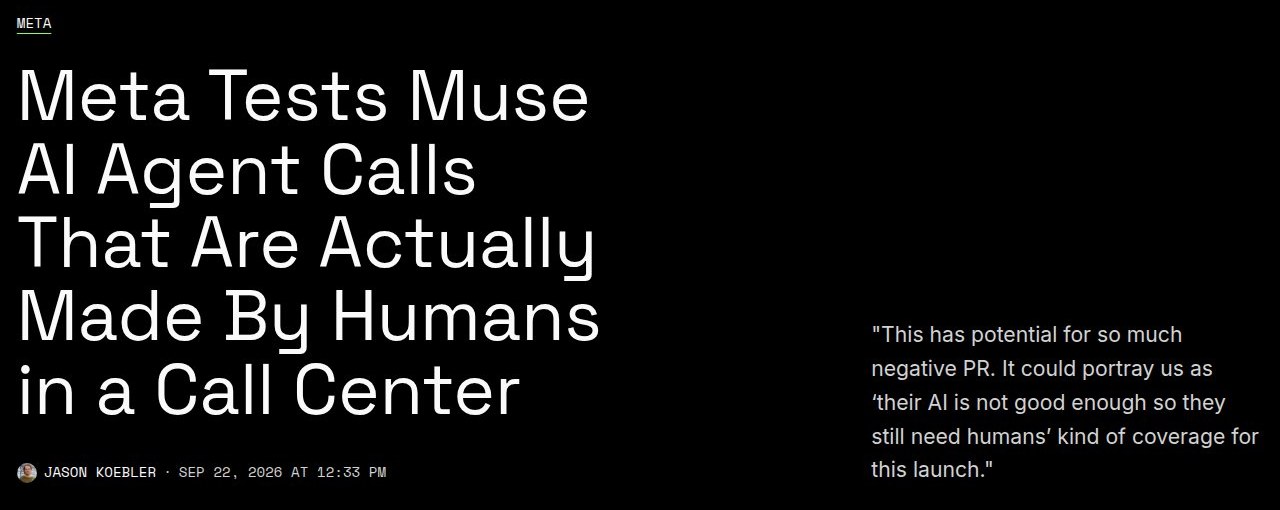
Meta’s Muse agent, publicly presented as an AI that independently calls businesses to make reservations and schedule appointments, relies on human call center workers for part of those calls. That’s according to 404 Media, which reported on September 22, 2026, based on internal Meta communications it obtained. Six days earlier, on September 16, Meta managers had announced the calling feature publicly as a demonstration of autonomous AI.
Let’s be clear about the frame first: this is a feature in testing. Meta itself calls it dogfooding, the practice of testing a product internally with your own people before the public gets access. So no customer has been deceived, because there is no public rollout yet. What the internal documents do show is how the feature works: Meta announced internally that it had “added a human agent layer for calls to get completed.” User requests can be routed to trained human agents, who then make the phone call on behalf of the user. When a call runs fully automated and when a human takes over remains unclear.
”Their AI is not good enough”
That the sensitivity is felt internally too shows up in the messages themselves. Alongside the note “Muse human agent calls is ready for company dogfooding,” 404 Media found this warning from a Meta employee:
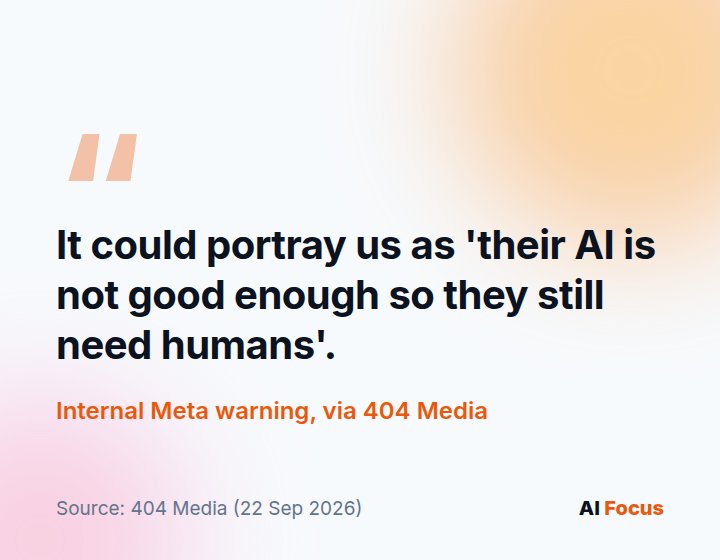
“This has potential for so much negative PR. It could portray us as ‘their AI is not good enough so they still need humans’ kind of coverage for this launch.”
Loosely translated: this could generate so much negative press, it could make us look like a company whose AI isn’t good enough and still needs humans. The employee predicted almost exactly the reporting that came six days after the public announcement.
On top of that comes the privacy question, which 404 Media itself raises sharply: you can easily imagine someone using Muse to schedule a sensitive doctor’s appointment without knowing that a human is making that call. Meta reassured its own employees internally that sensitive information handled by those “human contractors” stays safe, since the contractors had “a lot of training to make sure all your data is safe and secure.” The article says nothing concrete about scale, no numbers of calls or employees; the beta test covers calls to U.S. businesses.
Announcement Versus Internal Reality
Meta’s spokesperson doesn’t deny the documents, but frames them: “Internal testing, aka dogfooding, is core to the product development process.” The company promises “proper disclosures” before public rollout and says it is “working with merchants to continue improving this potential calling feature.” Set that alongside what 404 Media found, and you get this picture:
| What Meta Says | What the Internal Documents Show |
|---|---|
| Public announcement on September 16: Muse calls businesses independently as AI | A “human agent layer” where humans make calls; how often remains unclear |
| Spokesperson promises “proper disclosures” before public rollout | Already unclear when a human calls and when the machine does |
| The user expects an AI interaction | Sensitive requests (such as booking a doctor’s appointment) can land with human contractors |
Identification Must Cut Both Ways
The timing makes this story extra sharp. Just yesterday, Amazon shut out that same Muse, among other reasons because the agent doesn’t identify itself as AI while browsing. Today it turns out that some of Muse’s “AI calls” are actually made by humans. Identification must cut both ways: platforms demand that an AI identify itself as AI, and users are just as entitled to expect that a human identify themselves as human when suddenly someone picks up the phone.
We’ve seen this pattern before. At OpenAI, it turned out that hundreds of contractors read along with ChatGPT conversations: there too, the human layer was normal and necessary in itself, and the problem was that users didn’t know about it. And we saw the opposite lesson in the near-miss at sea, where people thought they were working with reliable machine output and nobody was watching. Every time, it boils down to the same question: do you actually know who or what is on the other end?
Our reading: this is not a scandal about a company testing with humans behind the scenes. That approach, known in product development as the Wizard of Oz method, is completely standard: you have humans play the role of the system to learn what the system eventually needs to do. The problem is the gap between presentation and reality. If you say “AI agent” on stage and deliver a call center in practice, you teach users exactly the wrong lesson. Because the right privacy lesson for 2026 is this: at any “AI” interaction, a human might be watching, and at any “human” interaction, an AI might be at work. The real question for the industry, then, is mandatory identification in both directions. Amazon yesterday demanded that agents identify themselves as AI; the least users can demand in return is to be told when a human is on the line. Meta promises “proper disclosures” before rollout. We will watch for it and measure the company against that promise.
Update 24 September 2026: Muse is now coming to Meta’s glasses too, including the camera-free Ray-Ban Meta Audio, from 13 October for €349 in Belgium.