
AI false report nearly triggered U.S. military operation on Chinese ship
A faulty intelligence report generated with AI nearly prompted the U.S. military to board a Chinese ship in the Middle East this spring. That’s according to CNN, which broke the story on September 18, 2026, based on four people familiar with the incident. The important caveat: this is reporting based on anonymous sources, not official confirmation. Much remains unknown, and we’re presenting it as CNN has, with attribution and without filling the gaps in the account ourselves.
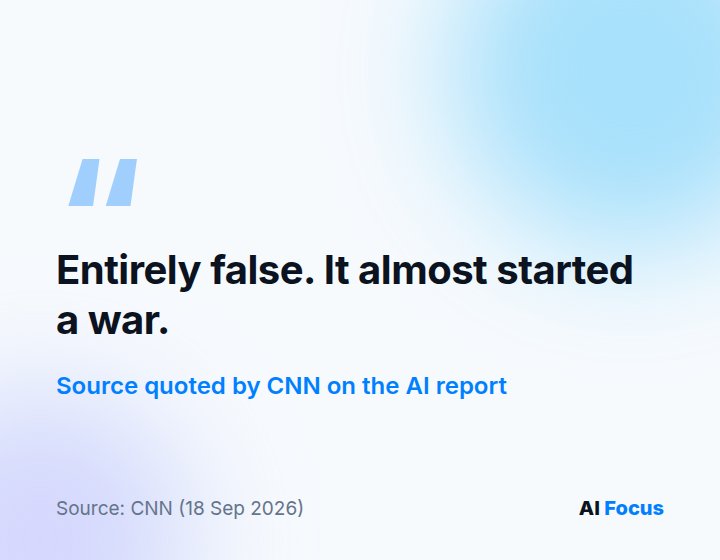
According to those sources, the incident took place during the conflict with Iran. The report claimed a ship was carrying nuclear weapons program components. Armed U.S. military personnel were positioned to board the vessel, and military aircraft had already launched, say two of CNN’s sources. Just before the operation was to begin, officials dug deeper into the report. That’s when they discovered it had been AI-generated and that a chatbot had misidentified the cargo being transported. One source called the report “entirely false” and said it “almost started a war.”
How a chatbot climbed the chain of command
The concerning part is the path the report took. According to CNN, it started with an analyst at U.S. Special Operations Command who queried a chatbot about intelligence surrounding the ship’s manifest, data originally from SOCOM Pacific in Hawaii. The bot combined open-source information with classified signals intelligence and reached an incorrect conclusion about the cargo. The same analyst then used AI again, this time to format the findings as a standard intelligence report, which was then distributed.
| Step | What went wrong |
|---|---|
| Analyst queries chatbot | An analyst at U.S. Special Operations Command asks a chatbot about the ship’s manifest, intelligence originally from SOCOM Pacific, Hawaii. |
| Chatbot merges sources | The bot combines open-source information with classified signals intelligence and misidentifies the cargo. |
| AI formats the official report | The analyst uses AI again to shape the incorrect findings into a standard intelligence report format and distributes it. |
| Report climbs the chain | The report moves up the chain of command. Armed personnel and aircraft stand ready without anyone checking the original source. |
That last step is the crux. A hallucination itself, a chatbot misidentifying material, is nothing new and not remarkable on its own. What made it dangerous is that the error took the form of a standard intelligence report and climbed the chain of command right up to the brink of boarding operations before anyone questioned it. This is the highest stakes version of the same problem seen in OpenAI’s own incidents, where models generated data and presented it as real. There, it stayed as fabricated numbers in a test environment; here, an armed operation hung in the balance.
What we don’t know deserves equal honesty. CNN couldn’t determine whether the chatbot used was a commercial product or a government tool, nor what the ship actually carried. So this remains one near-miss, reconstructed from anonymous sources. Still, it fits a broader pattern CNN describes: the concern that AI errors climb the chain of command before they’re scrutinized. In April, a senior Pentagon official told DefenseScoop that the department under Secretary Hegseth was “cattle-driving, as we say, everything in GenAI.mil”, driving everything toward generative AI wholesale. That pressure to rapidly integrate AI into everything is precisely the context in which an unchecked report can slip through.
Don’t ban AI: build in safeguards
The instinct when you hear this story is quick: AI has no place in military decision-making. But the most sober voice in the coverage takes a different line. Jake Steckler, research scholar at GovAI and a U.S. military veteran, told TechCrunch:
“It’s important for service members to understand the uncertainty inherent to LLMs.”
Service members need to grasp the inherent uncertainty of large language models, he argues. His point is not that AI should leave the battlefield, but that extra safeguards are required instead of abandoning the technology altogether. That’s the sensible middle path, and it runs counter to the flip side of the same coin. In the classroom study, it turned out that banning AI backfires and the problem was too little trust. Here it’s the reverse: not too little trust but too much and too fast, without the human oversight the tool deserves.
Our take
It’s tempting to read this as “AI is dangerous,” but that’s the wrong lesson. The real problem is procedural. A hallucination became not just a funny mistake but a life-threatening one, precisely because an official report format gave it credibility. An AI answer that looks like a routine intelligence report gets treated as one: forwarded, escalated, nearly executed. No human sat between the chatbot and the chain of command to verify the original source before the report went up, and the “cattle-driving” push to dump everything into AI only widens that gap.
The lesson, then, is not to ban AI but to lock down two things. Mandatory human verification for decisions with lives on the line, and AI output that never looks like a normal report but is visibly AI-generated, stamped with the uncertainty that comes with it. That aligns with what Steckler advocates: safeguards, not bans.
At the same time, a note of caution. This is one near-miss, documented from anonymous sources, with much still unknown. It’s not proof that AI systematically sparks wars. For the other face of AI in a security context this week, there’s a sister post ready: AI as hacker. Together they draw the same boundary: the problem is rarely the technology alone, but the oversight we build around it.
Update 26 September 2026: this very risk, AI hallucinating the wrong targets, was an argument Anthropic raised in its lawsuit against the Pentagon. An appeals court still sided with the Pentagon: it was allowed to blacklist Anthropic.