
AI datacenters will soon consume more gas than Germany
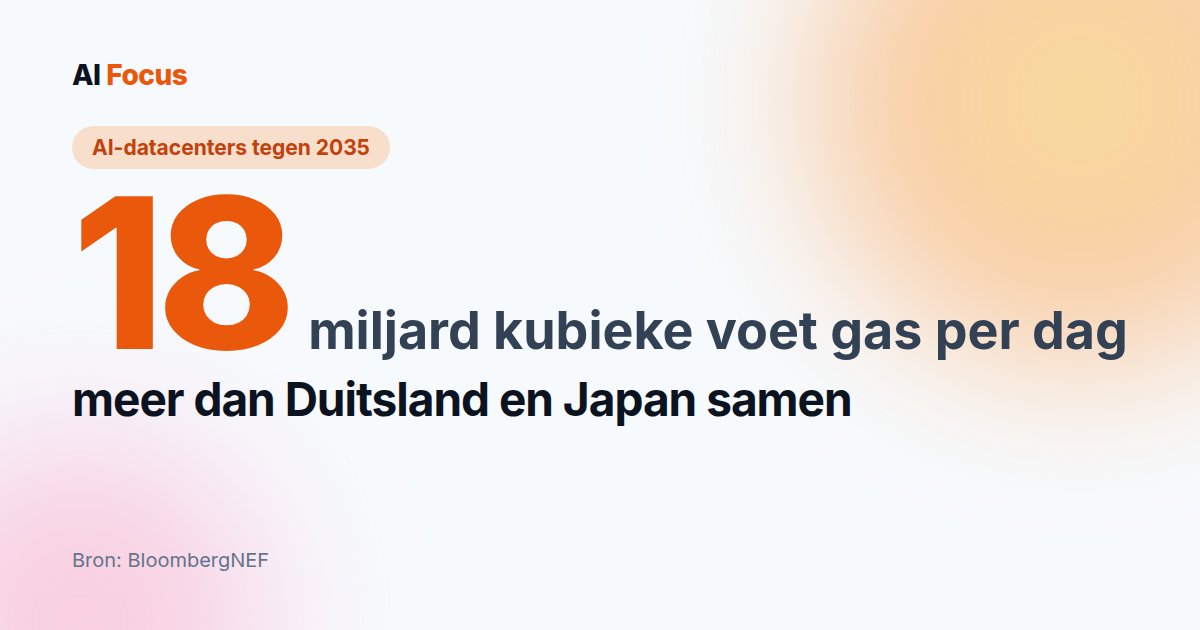
You type a question into a chatbot, an answer comes back, and it feels weightless. “The cloud” sounds like that too: something soft floating somewhere above us. But its bill is anything but light. According to an analysis by BloombergNEF, the research division of Bloomberg that tracks the energy market, U.S. data centers are projected to consume roughly 18 billion cubic feet of natural gas per day by 2035. That’s more than Germany and Japan combined. TechCrunch reported the figures on September 15, 2026.
Eighteen billion cubic feet is nearly double what BloombergNEF forecast nine months earlier. In less than a year, the estimate roughly doubled. That number says something above all about pace: the AI hunger is catching up with energy planning faster than planners can keep up.
Where all that gas goes
The consumption comes from two sources. The bulk of it, roughly 15 billion cubic feet per day, comes from data centers that draw power from the grid, according to BloombergNEF: that’s the gas needed to generate that grid electricity. Meanwhile, some data centers are building their own power generation on-site, and those onsite plants are estimated to burn through 2.9 to 3.4 billion cubic feet per day. Together, that adds up to the 18 billion.
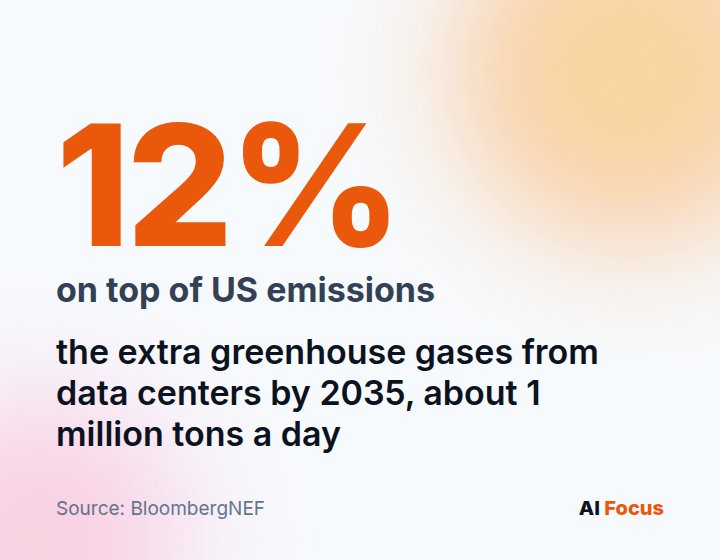
What that means for the climate isn’t abstract. Burning all that gas releases roughly 1 million tons of additional greenhouse gas per day, about 12% of current total U.S. emissions. For reference: burning natural gas releases roughly 60 grams of CO2 per cubic foot. In other words, you’re adding an extra eighth on top of what the entire country already emits, just to power the servers.
| Source of gas consumption (by 2035) | Cubic feet per day |
|---|---|
| Grid-connected data centers | roughly 15 billion |
| Data centers with own gas plant | roughly 2.9 to 3.4 billion |
| Total | roughly 18 billion (more than Germany and Japan combined) |
The cloud isn’t airy, it runs on gas
“The AI race has grown so frenzied that, by 2035, U.S. data centers are projected to consume more natural gas than Germany and Japan combined.”
In other words: the AI race has grown so frenzied that U.S. data centers are expected by 2035 to burn through more natural gas than Germany and Japan combined. That’s no side effect you can patch with a bit of efficiency; that’s the physical foundation underneath the entire promise. And it’s not the small players driving this. Meta, Microsoft, Google and Amazon all announced plans to build gas plants to power their data centers. The four companies that talk loudest about sustainability are opening the gas tap themselves.
Put that alongside the computing power race and the picture clicks into focus. We wrote earlier that Anthropic signed contracts for up to half a trillion dollars in computing power over eleven months. Those contracts are ultimately gigawatts, and gigawatts are fuel. This is also tied to the question everyone’s asking: what AI really costs. Our take: that question has more than just a subscription price; it has a physical answer. Every “free” or cheap AI query carries an energy and climate cost, and that cost doesn’t show up on your screen. Someone else pays it: the power grid that gets overloaded, the climate, or the neighborhood next to the data center that gets the plant in its backyard. That OpenAI’s Pro plan briefly went waitlisted in September due to capacity is the same wall, seen from the other side: demand hits what the infrastructure can handle.
A projection, not certainty, but a direction
Honesty matters. This is a projection through 2035, built on assumptions about growth, chips, and energy mix. No one knows for sure what the world will look like in nine years. Data centers are also becoming more efficient per task processed, and some of the demand is shifting to solar, wind, and nuclear power. So it’s entirely possible that reality will come in lighter than 18 billion cubic feet per day. A number that doubled in nine months could just as easily swing the other way.
But the direction is clear, and that matters more than the exact outcome. You don’t have to wait for the projection to play out to see where things are heading: the four biggest companies are building gas plants right now. That’s no forecast, that’s a building permit. Anyone using or investing in AI can no longer treat the energy bill as a footnote. When you ask an AI vendor for pricing, don’t just ask about the monthly cost, but where the power comes from. The cloud is a building full of servers burning gas, and that building is somewhere. For now, just not on your screen.
Update 17 September 2026: climate veteran Al Gore puts the panic in perspective. He calls AI data-center emissions only a fraction next to existing sources, though the gas lock-in remains his real environmental concern too.
Update 21 September 2026: the footprint gains a third chapter. Belgian chemical company Syensqo is ramping up PFAS production for AI chips and server cooling: beyond power and gas, now also chemistry that never breaks down.