Spot AI photos on Vinted: tips and your rights in Belgium
A secondhand dress that looks like it was shot in a studio. A virtual model “wearing” a sweater. According to VRT NWS, you now only need to scroll Vinted for a moment to come across AI photos like these. Often it’s harmless. Sometimes a stain, a tear or years of wear disappear with a single click.
What’s going on
On October 6, 2026, VRT NWS spoke with sellers, buyers and researcher Fien Demarest (Thomas More). A seller from Borsbeek puts one AI photo first, alongside a dozen of her own photos, and lists the defects in the description. That’s fine.
It can also go another way. A woman from Vilvoorde bought a set of weights for 180 euros that looked practically new in the photos. At home, they turned out to be “clearly heavily used, and completely bleached”. According to her, the listing photos were made with AI. “It’s very easy to use AI to remove a stain, wear, discoloration or damage,” says Demarest.
And it works both ways. According to VRT, citing testimonies gathered by the Dutch broadcaster NOS, some buyers use AI to add a hole or a stain to a photo so they can claim a refund they’re not entitled to. Vinted confirmed to VRT that AI-faked evidence in a dispute is banned as well.
What Vinted itself says about AI photos
This is where it gets awkward. Vinted’s written catalog rules leave little room. Photos must represent the item “as it is”, and “no image editing is allowed”. You have to show defects, scratches and wear. The photos must be taken by you for use on Vinted, and stock photos or images from ads are not allowed. “Using photos that you didn’t take, aren’t of the actual item, or don’t accurately represent the item” counts as intentionally misleading buyers.
To VRT NWS, Vinted sounded more lenient. Using AI to visually enhance photos is allowed, “provided the photo remains an accurate representation of the item”. Real photos must always be included, though. And sellers don’t have to disclose that they used AI. According to Vinted, anyone who uses AI to mislead risks having a listing removed or an account suspended. Vinted won’t say how many reports it receives, only that such cases “generally represent a minority”.
| Allowed according to Vinted | Not allowed according to Vinted | |
|---|---|---|
| Real photos | Mandatory: taken by you, of the actual item, first photo shows the whole item | Stock photos, photos from ads, images with a watermark |
| AI editing | Visual enhancement, as long as the photo stays accurate (statement to VRT) | The written rules list image editing as not allowed |
| Defects | Show them in the photos and the description | Removing stains, wear or damage |
| Disclosing AI use | Not required (statement to VRT) | No disclosure requirement in the written rules |
| Evidence in a dispute | Real photos of what you received | AI-faked evidence, such as an added hole |
How to spot AI photos on Vinted
Belgium’s FPS Economy has a practical fact sheet on the subject. According to the FPS, scammers on these platforms sell new, poor-quality products as “vintage”, using AI photos in fictional settings. AI editing is not illegal in itself, but it is when the image misleads the consumer, “for example by making the item look better than it really is”. The FPS’s tips:
- Look out for details that seem suspicious or abnormal: misshapen or oddly placed hands, anonymized faces, overly perfect settings.
- Not sure whether a garment is really old? Do a reverse image search, for example with Google Lens. If you find the same piece on a cheap shopping platform, you know enough.
- You should be able to identify the seller. A missing or inconsistent profile photo, or contact details you can’t find, are red flags.
- Read the reviews, but critically: some scammers write their own glowing reviews.
- Pay through the platform’s own services, never through an alternative payment method the seller suggests.
Three checks of our own on top of that, not official tips but common sense:
- Besides a polished photo, are there also ordinary photos of the item? Vinted says it requires them.
- Watch for missing wear. A secondhand piece without a single bobble, scratch or faded spot, while the description says “worn” or “used”, is suspicious. That’s exactly how the Vilvoorde weights looked in the photos.
- If in doubt, ask for an extra photo of the label or of a detail you choose. Anyone who really has the item can take one in a minute.
What if your item doesn’t match?
Vinted’s refund policy applies to purchases made with the “Buy now” button from regular members, not from Pro sellers. If you pay outside Vinted, you’re not protected, according to Vinted.
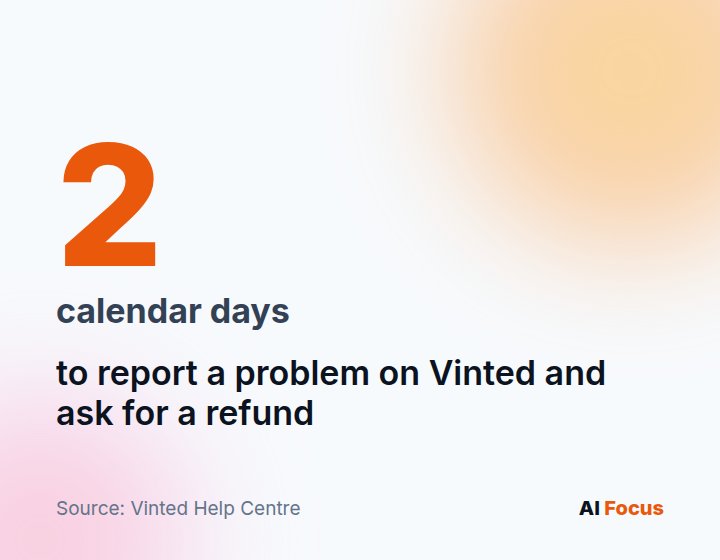
- Be quick. You have 2 calendar days to report an issue. That period starts when Vinted lets you know that your order should have been delivered. If you report nothing, or confirm that everything is fine, your money goes to the seller and Vinted can no longer help.
- Press “I have an issue” in the conversation and follow the steps. Say what you want from the seller, for example a full or partial refund. Once you’ve submitted your request, the order is paused and your payment stays safe until the issue is resolved.
- Back everything up with photos: the item and the problem, the outer and inner packaging, and any damage to the packaging. Keep the packaging until your case is closed. Without photos, Vinted may not be able to refund you.
- Know where the line is. According to Vinted, an item counts as “significantly not as described” if, for example, it’s the wrong color or size, or has damage that wasn’t in the description and wasn’t visible in the photos either. So a stain that was edited out and that the seller never mentioned falls under this. Minor differences that don’t affect the look or use don’t count. An item you simply don’t like or that doesn’t fit is not covered.
If you have to send it back, you do so within 5 working days of the seller requesting a return. Return shipping is at your expense, unless the seller pays for it. If you can’t reach an agreement, Vinted’s support team decides.
As for the law: if you buy from a private individual, the statutory warranty does not apply, the FPS Economy writes. Vinted’s own procedure is then your safety net. With a Pro seller it’s the other way around: they must be registered as a business, and according to the FPS, purchases from a business are covered by the two-year statutory warranty. If you’ve genuinely been scammed, the FPS advises filing a complaint with the local police and with the platform, and reporting the fraud via ConsumerConnect. If you shared your bank details, call Card Stop immediately (078 170 170).
Selling yourself? How to stay on the right side
An AI model wearing your dress protects your privacy: you don’t have to be in the photo yourself, says Demarest. Vinted tells VRT that such an image is allowed alongside real photos, although the written rules still ban image editing. If you want to play it safe: stick to one extra image, put your own photos next to it and list defects in the description. A photo that removes a stain is misleading, and misleading is illegal according to the FPS Economy, with or without AI.
Protect yourself against false complaints too. Demarest recommends taking clear photos before shipping, “including details, labels and any damage”, and photographing or filming the packing. The same woman from Vilvoorde shows how that can play out. When she sold a pair of pants herself, the buyer sent a close-up of a hole that, according to her, was never there. She pointed out to Vinted that the photo had to be AI-generated, and Vinted sided with her.
Our take
Vinted tells two stories. On paper, image editing is banned; to the press, AI enhancement is allowed as long as the photo stays accurate. Maybe the rules are simply lagging behind practice, but then Vinted should update them. That second rule is more realistic, but vaguer: who decides when a touched-up photo becomes too good to be true? A mandatory “AI-edited” label would cost little. How hard authenticity is to prove was already clear from Apple’s Reference Image and the watermark ChatGPT is getting in the EU.
Still, as a buyer you’re in a stronger position than you think. You don’t have to prove that AI was used. You have to show that what you received is clearly different from the listing, with a defect that wasn’t in the description and wasn’t visible in the photos. The seller can dispute that, but then Vinted decides, not the seller. So always buy with the “Buy now” button, open your parcel right away and, if in doubt, photograph everything the same day. Two days go by fast.