ChatGPT gets a watermark in the EU: what does that mean?
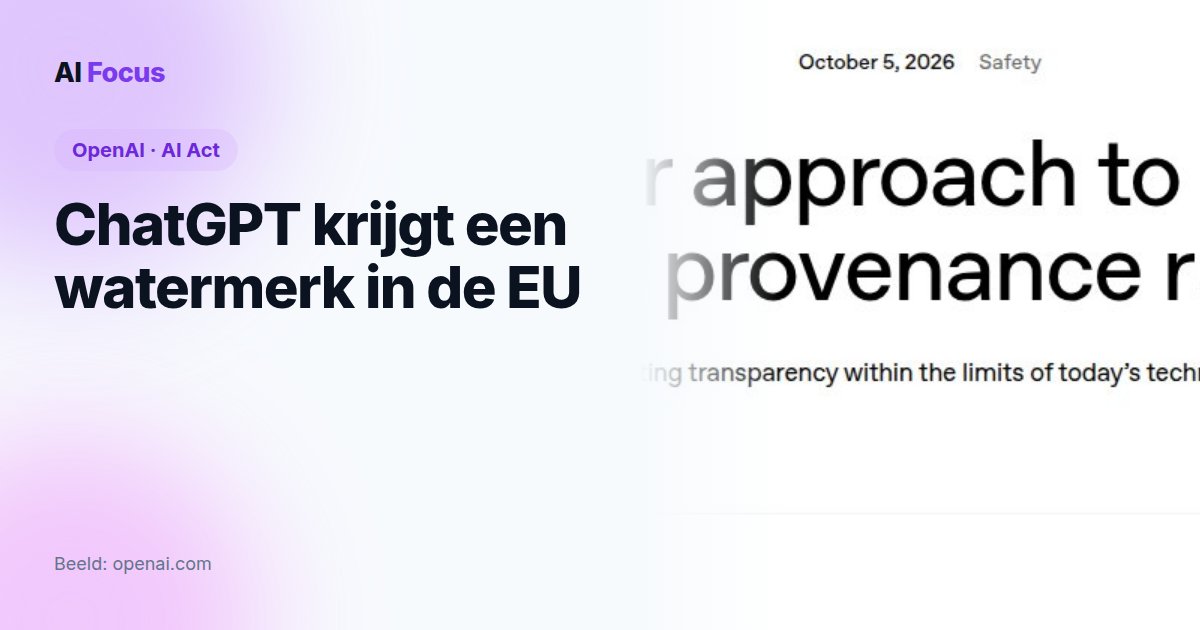
Text from ChatGPT is about to get a hidden stamp in Europe. On October 5, 2026, OpenAI announced in “Our approach to EU text provenance rules” that it will add “over the coming weeks” an invisible watermark to “eligible” text from ChatGPT and Codex in the European Union, for users “across all plans”. The reason is the AI Act. Outside the EU, nothing changes for now.
If you use ChatGPT for a paper or report, it might sound like “they can now see I used AI”. It is not that simple. The watermark is in practice mainly a label for researchers and platforms, and it is easier to lose than you might think.
What does the ChatGPT watermark do?
The watermark is called textGrain. It adds, according to OpenAI, “an invisible statistical signal to the model’s word choices”: the model chooses certain words slightly more often, following a pattern you as a reader cannot see, but a detector can recognize statistically. On the benchmarks of Astra, which OpenAI calls its latest frontier model, the company says it sees no meaningful performance differences with and without the watermark (“we do not see meaningful performance differences”).
The rollout is split into three parts:
- ChatGPT and Codex in the EU: watermark on “eligible” text output, over the coming weeks, on all plans. OpenAI does not say which output exactly qualifies. OpenAI deliberately does not make it a global standard.
- The API, worldwide: since October 5, customers can turn on the watermark for a number of models, but it is off by default.
- The detector: only “approved researchers and expert organizations” can request access, case by case. The tool only says whether an OpenAI watermark is present, without showing the user, the prompt, or the conversation.
OpenAI says textGrain scored as well as or better than other approaches in its own tests, including Google’s SynthID for text, and wants to open source the technology. For images and audio, OpenAI’s verification tools remain public.
What the watermark can do, and mostly what it cannot
OpenAI is surprisingly honest about the limits. Two factors break detection: length and editing.
At a false-positive rate of 1% (the detector sees a watermark that is not there in 1 out of 100 cases), the system found the watermark in roughly 80% of passages of 200 tokens and in roughly 95% of passages of 400 tokens, on answers to psychology questions. Tokens are the pieces into which a language model splits text, roughly a word or part of one. In math, detection was “substantially lower”, because there is less freedom in word choice.
Then editing, the number every student and employee should know.
After a quarter of the words are replaced, the detector no longer finds the watermark in roughly five out of six cases. Text that is heavily edited, translated, or only partly used will often fall outside its reach. OpenAI says so itself: text can be “too short, edited, or translated” to detect reliably.
Even more important is what a positive result does not say. OpenAI lists it: a watermark does not measure how much human work went into it, says nothing about ownership or responsibility, does not identify the user, and does not check whether the text is correct. And conversely: “The absence of a detected watermark does not prove human authorship.”
| Question | Does the watermark say so? |
|---|---|
| Did an OpenAI system make or edit (part of) the text? | It can suggest so if the detector finds the signal |
| How much did you write or improve yourself? | No |
| Who made the text (account, prompt, conversation)? | No |
| Is the text correct and can you use it like this? | No |
| Is text without a watermark written by a human? | No |
Why now: the AI Act
The AI Act, the European AI regulation, requires in Article 50 that providers of generative AI mark text, images, audio and video “in a machine-readable format”, so that it is detectable that the content was made by AI. According to the FAQ of the European Commission, Article 50 applies “as from 2 August 2026”.
There is one limited transition period. For AI systems that were already on the market before August 2, 2026, only the marking obligation (Article 50, paragraph 2) does not apply until December 2, 2026; the other transparency rules already apply. This transition period came through the Digital Omnibus, this summer’s simplification package for the AI rules. ChatGPT was on the market long before August, so our inference is that OpenAI falls under that transition period and that “the coming weeks” are aimed at December 2. OpenAI does not say so itself. Those who violate Article 50 face fines up to 15 million euros or 3% of global annual turnover, according to the Commission.
Not everything must be marked. The Commission excludes, for example, source code that only passes between machines without a human seeing it, and output of a system that only helps with standard editing work. Which Codex output OpenAI considers “eligible” is not stated in the announcement. For the detector, OpenAI points to the Code of Practice on marking AI-generated content, which the Commission published in June 2026.
What changes for you?
As a student less changes than you might fear. Your teacher cannot simply run your paper through OpenAI’s detector; it is not public. But that is no free pass. Other detection tools do exist, and a teacher who knows your writing style often notices more than an algorithm. Our advice: check what your school’s or college’s rules say. Is AI allowed, for which steps, and do you need to disclose it? The fact that banning AI from the classroom backfires does not mean anything goes.
As an employee the watermark changes little. Whether you can use ChatGPT for a memo or email is decided by your employer, not the watermark; if there is no AI policy, ask. The bigger risk lies elsewhere, in our view: what you paste into the chatbot. Read our guide on GDPR and AI at work for that.
As an entrepreneur making web copy or newsletters with ChatGPT, your text may from now on carry an invisible label. If you publish AI text to inform the public about matters of public interest, you must label it visibly as AI text under the AI Act (Article 50, paragraph 4), unless a human actually reviewed the content or there was editorial oversight, and someone carries editorial responsibility. A spelling or grammar check does not count for that. In our view, a product description or price quote does not normally fall under that.
If you build via the API, the watermark is off by default. Whether you must turn it on to meet your own obligations is a question for your lawyer, not OpenAI.
Our take
This watermark is no AI snitch, and that is good. OpenAI’s own figures show why: a detector that finds only 17% after a quarter of synonyms, and that in the tested setting alarms on roughly 1 in 100 texts without a watermark, does not belong in the hands of an exam committee or HR department. Shielding the detector is therefore smart. A public “is this AI?” button could wrongly accuse students and at the same time clear anyone who quickly reworks a text.
The strongest counterargument deserves a hearing: what is a label worth that falls off so easily? For the individual student or employee, not much. But for disinformation at scale, where thousands of unedited messages circulate, a statistical signal can help detect misleading AI content, just as Apple with Reference Image tries to prove authenticity at the source. There lies the use, not in your paper.
Two uncertainties remain. The published figures cover English-language answers from the ELI5 dataset; OpenAI does not say how well textGrain recognizes a Dutch-language text. And the figures come from OpenAI itself; independent measurements will only follow once the researchers can get to work.
What you do with this: do not count on the watermark, in any direction. If you use ChatGPT for school or work, agree on what is allowed and simply say so when you have used it. A sentence like “first draft created with ChatGPT, reviewed and edited” costs nothing and protects you better than hoping no one notices.
Update 8 October 2026: Google is going about it the other way. On 7 October, it made its SynthID Detector public worldwide, for now in English: anyone can check whether an image, video, or audio file was created with AI from Google or partners such as OpenAI. Google has, by its own account, already watermarked over 180 billion images and videos. Google does not mention text in that announcement. OpenAI’s text detector remains, meanwhile, available only to approved researchers.