SAP acquires Ghent’s TechWolf: AI that maps your skills
A Ghent AI company is heading to the German software giant SAP. On October 6, 2026, SAP and TechWolf announced that SAP is acquiring the company, according to the SAP press release. The deal is expected to close in the fourth quarter of 2026, “subject to usual closing conditions, including regulatory approval”. Both parties remain silent on price. According to VRT NWS, De Tijd mentions hundreds of millions of euros, but this figure is not confirmed.
Good news for Ghent. But what TechWolf is selling will soon affect employees of large companies running on SAP as well.
What does TechWolf do?
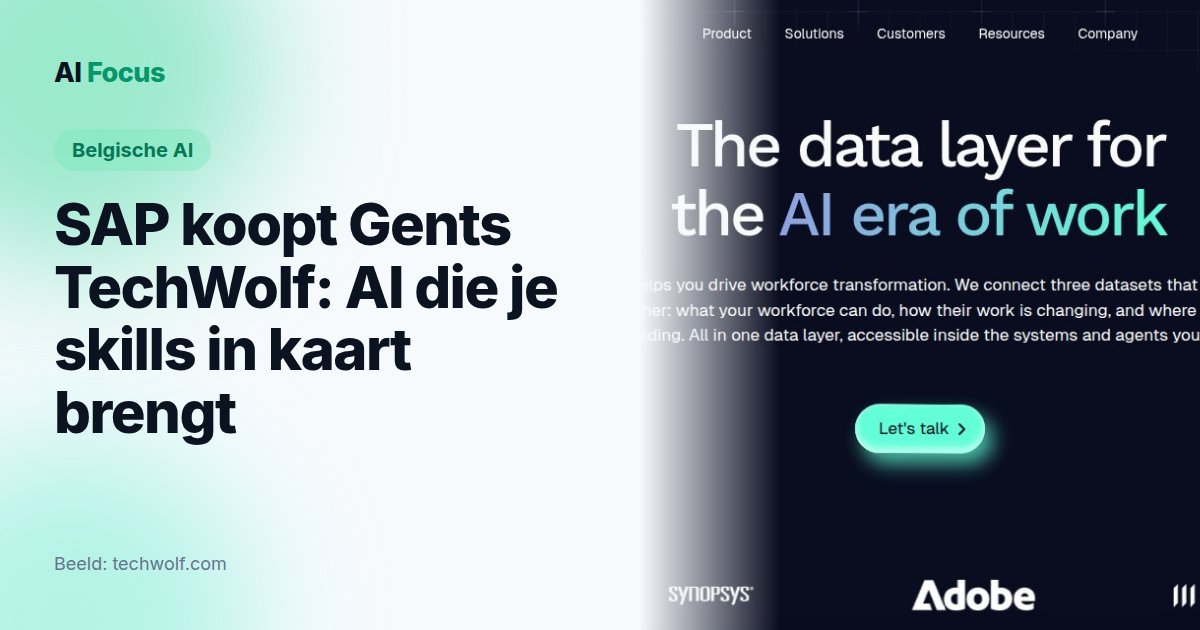
TechWolf was founded in 2018 by three Ghent University students: Andreas De Neve, Jeroen Van Hautte and Mikaël Wornoo. It doesn’t build a new HR package, but rather a layer on top of existing ones. From the HR and business systems a customer plugs in, it creates what it calls a “context graph for work”: a data model of what work happens, what skills people have and use, and how that relates to the labor market.
According to SAP, this goes “down to the tasks inside a job”. CTO Jeroen Van Hautte put it more simply to VRT NWS (our translation):
“We map what happens inside a company and which skills are present. Thanks to that data, companies can see where new technologies have an impact and which people can be guided toward a new opportunity.”
The difference from a traditional skills database, where employees tick off their own skills: TechWolf starts with data already sitting in the company’s systems. The press release lists customers including HSBC, Atlas Copco, GSK, Ericsson, AMD, MetLife, PayPal and Booking.com.
Why SAP wants this
SAP already sells HR software to large companies through SuccessFactors. According to the press release, TechWolf is to become “an intelligent core” of it. The real reason sits in the quote from Manoj Swaminathan, product lead at SAP: the context graph is “an excellent grounding layer for agent queries”, a factual foundation AI agents can rely on. It “makes token usage more efficient, lowers the cost of deploying workforce agents” and is meant to make Joule, SAP’s AI assistant, smarter in areas like skills-based hiring, workforce planning and job redesign.
Translated: an AI agent answering questions about personnel is only as good as the data underneath it. TechWolf already supplies that data in structured form. That’s cheaper than having a language model dig through HR files each time on its own. The same math applies everywhere: what AI costs a company depends on the meter, and fewer tokens per query means money saved.
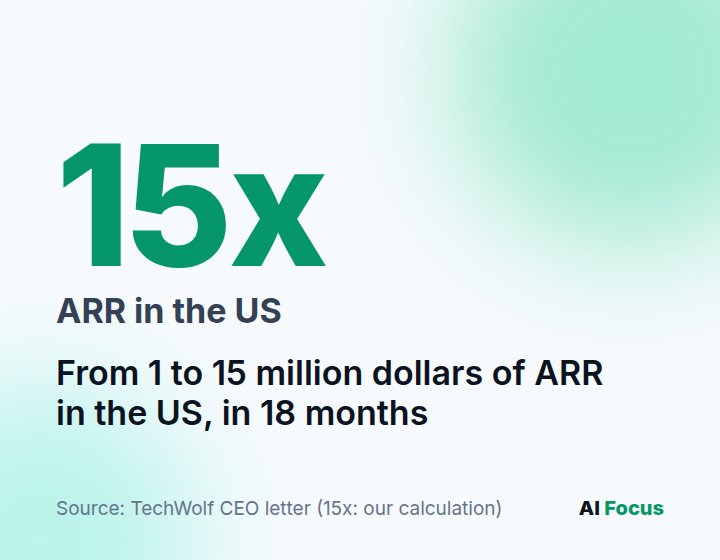
TechWolf itself gives its reason in the letter from CEO Andreas De Neve. Annual recurring revenue in the U.S. grew from 1 to 15 million dollars over the past 18 months, yet by its own account it couldn’t keep up with demand. Moreover, much of the proof of how work actually happens sits in operational systems, and “many of the world’s largest companies run those operations on SAP”. For comparison: across the entire company, revenue in the fiscal year through January 2026 stood at 8.68 million euros according to VRT NWS. Two different measures, but the direction is clear.
A Belgian success, with a question mark
According to VRT NWS, investors including PMV, the Flemish government’s investment company, came on board in 2020. In 2022 TechWolf raised 10 million euros, and in 2024 another 40 million euros, with SAP already among the investors at that last round. The buyer knew the company from the inside, then.
| Year | What happened |
|---|---|
| 2018 | Founded by three Ghent University students |
| 2020 | PMV (Flemish government) and others invest |
| 2022 | Capital round of 10 million euros |
| 2024 | Capital round of 40 million euros, with SAP as investor |
| October 6, 2026 | SAP announces acquisition, expected to close in Q4 2026 |
The team is sharing in it too. According to Van Hautte, every employee holds shares; he told VRT NWS it was “the largest liquidity event for employees ever in Belgium” (our translation). De Neve writes that founders, team and investors are donating 3% of the sale value to the new TechWolf Foundation, a charity. SAP plans for TechWolf to remain an independent entity under De Neve, with headquarters in Ghent, and for the platform to remain available to customers not using SAP. Note, though: those are “current plans”, “subject to closing and required consultation”. Co-founder Mikaël Wornoo is leaving the company; Van Hautte is relocating to San Francisco to open an office there.
Our take
First, the compliment. Three students build an AI company in eight years with HSBC and PayPal as customers, and SAP wants to buy it. Whoever thinks Belgian AI stays stuck in labs and papers can revise that view. That employees share in the proceeds is an example every Flemish scale-up should follow.
But the pattern is familiar. A company grows in Ghent, with money from PMV, and thus the Flemish government, in an early round as well, and when it breaks through it ends up in German hands. That’s no criticism of the founders: if you can’t keep up with U.S. demand, you need scale, and Europe has few buyers with that kind of scale. It’s a question for Flanders, though. As long as our strongest AI companies are sold rather than becoming buyers themselves, we remain mostly a breeding ground. “Ghent stays important” is a plan for today; whoever makes the big decisions later is a parent company in Walldorf.
What does this mean for employees?
SAP wants to build TechWolf into SuccessFactors. If you work at a company using that, your skills could be inferred by AI in the coming years from what you leave behind in the company’s systems. That can work in your favor: an internal opening you’d never have seen, training that fits you. It can also cut the other way if a reorganization relies on the same profile.
Europe has rules for this. The AI Act lists in Annex III, point 4, AI for recruitment and selection among the high-risk systems, just like AI influencing decisions on promotion or dismissal, assigning tasks “based on individual behaviour or personal traits” or monitoring and evaluating performance and behavior. Whether a concrete application falls under these rules depends on what the employer uses it for. These strict rules apply later, though: the AI Omnibus pushed them to December 2, 2027, the European Commission confirms. We explained that in our GDPR guide.
GDPR, however, already applies today. Article 22 gives you the right not to be subject to a decision that is made solely by automated means and significantly affects you. If such a decision is allowed anyway, for instance because it’s needed for your employment contract, you have at minimum the right to human intervention, to state your position and to contest the decision. TechWolf itself points to EU data residency and ISO/IEC 42001 certification. How an employer actually deploys the tool isn’t in there.
What you can do, then: ask HR or your union representatives which systems infer your skills, from which data, and who gets to see the result. If you work in HR or IT at an SAP customer, make sure those answers are ready before the first employee asks. The technology from Ghent is strong; how it’s used is up to your employer.