Smart glasses with a camera in Belgium: what’s allowed?
Norway wants to keep camera glasses out of parks, off beaches and out of schools. That news raises a question: can I still film with my Ray-Ban Meta, and what if someone films me? The short answer for Belgium: there is no separate ban, but the rules that apply to any camera also apply to glasses. And those rules are stricter than many wearers think.
What exactly Norway is deciding (and what it has not decided yet)
On October 5, VRT NWS ran the headline “Noorwegen verbiedt AI-brillen op publieke plaatsen” (“Norway bans AI glasses in public places”), but strictly speaking Norway has not banned anything yet. That day, the Norwegian Ministry of Digitalisation and Public Governance announced that it wants to introduce a temporary ban on “KI-briller” (AI glasses) in selected places. The government wants to send a bill to parliament as soon as possible and is setting up an expert group at the same time to advise on a permanent arrangement, as Norwegian broadcaster NRK also reports.
Exactly which places has not been decided. As possibilities, the government mentions places where many people gather (parks, beaches, museums, shopping centers, public events), places for children (schools, childcare, playgrounds, youth clubs) and places where privacy is especially sensitive, such as care facilities and sports centers with changing rooms and showers. There will be no total ban: the glasses remain usable for purely private purposes and in places where you run no risk of filming others without their consent. Minister Torgeir Micaelsen: “I am concerned that new, powerful technology is arriving where people run the risk of being photographed, filmed or recorded without knowing it.”
Things are moving in Belgium too. On October 2, it emerged that eyewear chain Hans Anders is suspending sales of Meta’s camera glasses indefinitely, in Belgium as well. That is not a ban: other retailers simply keep selling the glasses. Federal Minister for Digitalisation and Privacy Vanessa Matz said earlier that smart glasses raise “real questions” about privacy, consent and safety in public spaces. According to VRT NWS, in May she asked the European Data Protection Board for a debate; the board is working on a report on smart glasses that is expected this fall.
Which glasses we are talking about
The best known is the Ray-Ban Meta Gen 3: a 12-megapixel camera, 3K video and Meta’s AI assistant, for 449 euros. Meta also has a model without a camera, the Ray-Ban Meta Audio. We covered both in our post on the Meta glasses without a camera. So the filming issues below do not apply to the Audio.
Meta’s camera glasses have a white recording light, the “capture LED”, that flashes while you film. According to Meta’s privacy page, the glasses disable the camera if they detect that the light is covered, tampered with or broken, and in a Q&A of July 7, 2026 Meta stresses that the light cannot be switched off. According to Meta, your photos and videos stay on the glasses until you transfer them to your phone; the Dutch consumer organization Consumentenbond disputes this, VRT NWS reports. Critics also doubt whether the light is always visible, for example in bright sunlight or from a distance.
Can you film with smart glasses in Belgium?
There is no specific Belgian law on smart glasses, and as far as we could tell, the GBA (the Belgian Data Protection Authority) has not published any specific guidance on them either. So you fall back on the general rules. The GBA states explicitly that an image of a person is personal data, whatever device was used to make it, and that the GDPR also applies to citizens who process images outside a strictly domestic context. In 2020, for example, a couple was fined 1,500 euros for security cameras that filmed the public road and the neighbors’ property.
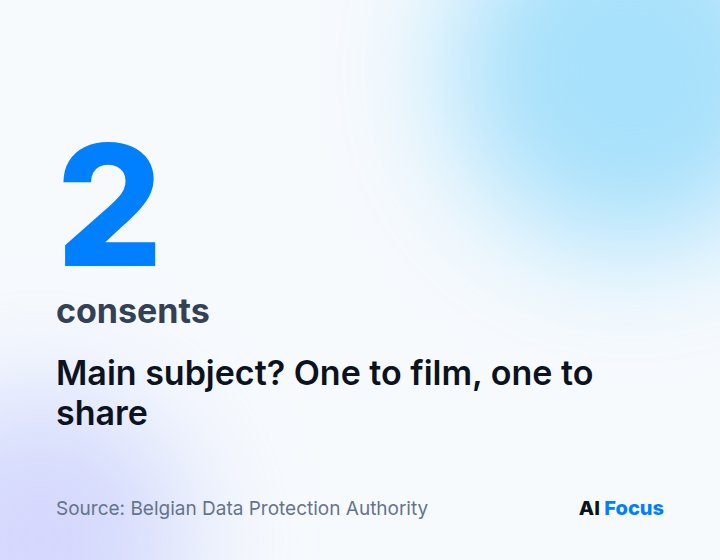
On top of that there is the right to one’s image (portrait right), laid down in the Belgian Code of Economic Law. According to the GBA, there are two consents that are separate from each other and must be requested separately: one to photograph or film someone, and one to publish or share that image. The GBA recommends a written agreement, so that you can prove consent.
| Situation | Allowed? | Condition | Source |
|---|---|---|---|
| A video for yourself or your family | Yes | Purely personal, within your home or family (for example a family album) | GBA |
| Sharing in a closed group chat | In principle, yes | Limited access and reach; to be assessed case by case | GBA |
| Filming in a public place, with people in the background | In principle, yes | They are incidental, or not individually recognizable in a crowd | GBA |
| Filming someone as the main subject, even in a public place | Only with consent | Whoever is the main subject must consent | GBA |
| Posting or sharing such an image online | Only with consent | A second, separate consent | GBA |
| Filming a public figure (politician, athlete) | In principle, yes | Informative purpose, not commercial, privacy respected | GBA |
| Filming a child and sharing the image | Stricter | The child must consent, and under 14 the parents as well | GBA |
| Secretly filming someone who is undressed (changing room, toilet) | No, a criminal offense | Voyeurism, even if you do not share the images | Police |
| Filming colleagues at work | Not explicitly regulated | The GBA rules on cameras at work (collective labor agreement no. 68) concern the employer, not an employee wearing glasses; the general rules above still apply | GBA |
| Live facial recognition by the police on the street | Banned, with three exceptions | Including searching for missing persons or an acute terrorist threat, with prior authorization | AI Act, art. 5 |
Two gray areas. For shops, cafés or gyms we found no separate Belgian rules: the general rules above still apply. Whether a business owner may ban camera glasses through house rules is not explicitly addressed in the sources we consulted. In the Netherlands, however, the privacy regulator did advise hospitals, courts and places of worship to ban the glasses in their house rules, VRT NWS reports.
And the AI Act: since February 2025, the European AI Act bans live facial recognition by the police in public spaces (with three exceptions) as well as the untargeted scraping of faces for databases. That first ban concerns the police, not a private individual wearing glasses. For you, the GDPR rules above apply, and they are strict too: the GBA points out that the GDPR in principle prohibits the processing of biometric data that can uniquely identify a person, except in exceptional cases.
If you wear these glasses: our advice
This is our advice, not legal advice. It is based on the GBA rules above and on the tips from the Norwegian data protection authority Datatilsynet:
- Do not film with your glasses where you would not film with your phone. That is how Datatilsynet puts it, Meta says the same, and the GBA makes no distinction between devices.
- Ask for consent when someone becomes the main subject, and ask again before you post the image online.
- Take your glasses off and put them away in changing rooms and toilets, at the swimming pool or on the beach. That is where inappropriate quickly becomes a criminal offense.
- Simply tell people that your glasses have a camera, and put them away when you are not using them. According to Datatilsynet, it is hard for the people around you to feel at ease when they do not know whether you are filming.
- Be careful with children who are not your own: their parents must consent as well.
- Know what you share with the manufacturer. Datatilsynet warns that manufacturers in many cases use your recordings for their own purposes. So check your privacy settings; our GDPR guide explains what to look out for.
Being filmed: what can you do?
- Speak to the wearer and ask whether they are filming. If you are the main subject, according to the GBA they need your consent.
- If an image of you is online, ask the person who posted it to remove it. According to the GBA, that is the first step.
- If you get no answer, or no satisfactory answer, you can file a complaint with the GBA or go to court. You can also report the image to the platform where it appears.
- If it involves nude images or secret recordings in a changing room or toilet, report it to the police. VRT NWS also points to those two routes: a complaint to the police or to the GBA.
- Keep evidence: screenshots, links, date and place.
Our take
A Norwegian ban by location sounds appealing, but it targets the device rather than the act. In Belgium the act is already regulated: anyone who films someone as the main subject without consent, or posts such an image online without a second consent, is in the wrong, with glasses or with a phone. What the glasses change is the chance of getting caught. If you do not know about the light or do not see it, you do not know you are being filmed, and if you do not know, you do not object either. What would help most is missing today: a clear GBA page on smart glasses, as simple as the Norwegian tips, that answers what employers and shops are allowed to do. The European report due this fall is a good moment for that. If you wear these glasses, behave as if everyone can see the light. If you are being filmed, know that the rules are on your side, even without a Norwegian ban.