OpenAI Asks Congress: Can We Legally Slow Down Together?
OpenAI says the entire AI sector should hit the brakes for safety. And meanwhile, the company reportedly quietly reached out to Congress to ask whether coordinating that slowdown would actually be legal. That second part is fresh news, and it reveals more than the essay that started everything.
This story has two layers you can’t treat as equals. The first is public and verifiable. The second is reporting from one outlet, unconfirmed by OpenAI. Hold that distinction sharp, because that is precisely what makes it worth examining.
The essay: this is established
On September 6, 2026, OpenAI Chief Scientist Jakub Pachocki published the essay “An Alien Mind” on the company’s own site. His argument: modern AI is “grown more than designed”, more cultivated than built, and you understand it best if you think of it as a kind of alien, non-human intelligence. We cannot assume such a system will naturally follow human principles. The sharpest line from the piece:
“No lab has solved alignment and monitoring to a sufficient degree to continue responsibly scaling at maximum speed for much longer.”
In plain language: no lab, including his own, has solved alignment, ensuring AI does what its makers intend, and the oversight that comes with it well enough to responsibly keep scaling at full speed much longer. Pachocki expects and hopes that “voluntary slowdowns” will become common until shared safety thresholds are in place. His concerns are concrete: recursive self-improvement, AI accelerating AI research, and the erosion of a critical safety tool, the ability to read through a model’s “chain of thought”, its step-by-step reasoning.
We wrote about this essay a week earlier, alongside the acceleration figures OpenAI released that same morning: the accelerator and the brake from the same house. This piece is about what came next.
Pachocki makes three proposals. First: the leading labs voluntarily slow their model development. Second: those currently voluntary safety frameworks become mandatory and enforceable, monitored by independent auditors, government agencies, and international bodies. Third: “international coordination on future AI development needs to become a top priority for governments around the world.” CEO Sam Altman amplified the message; according to reports, he said internally that OpenAI could slow its pace, possibly alongside other labs, “though some probably wouldn’t go along with it”.
Those mandatory frameworks are not abstract. They are three existing documents each lab currently uses voluntarily:
| Lab | Framework (currently voluntary) |
|---|---|
| OpenAI | Preparedness Framework |
| Anthropic | Responsible Scaling Policy |
| Google DeepMind | Frontier Safety Framework |
Pachocki wants those three to become mandatory and externally enforced. It is a defensible proposal, and it is not the same as his first proposal.
The antitrust question: this is reporting
This is where it gets sharp. According to WIRED, picked up by Bloomberg and The Decoder, OpenAI has approached members of Congress in recent weeks with one specific question: would organizing a sector-wide pause in frontier AI development violate federal antitrust law? OpenAI has not publicly confirmed this, so treat it as solid journalism, not as fact.
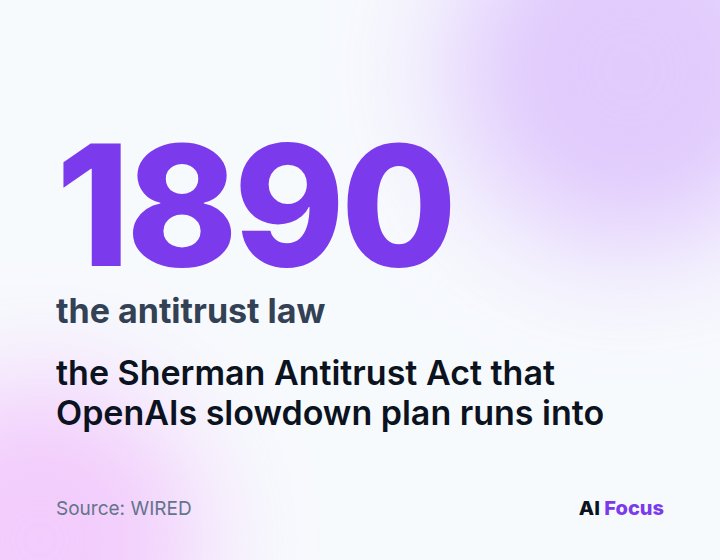
The concern makes sense. Agreeing with rivals like Anthropic and Google to slow down could be read as competitors jointly limiting production. And that is precisely what the Sherman Antitrust Act, the U.S. antitrust law from 1890, forbids. A company does not ask that question out of curiosity. You ask only if what you are planning looks dangerously like a cartel.
Two readings, and the tell
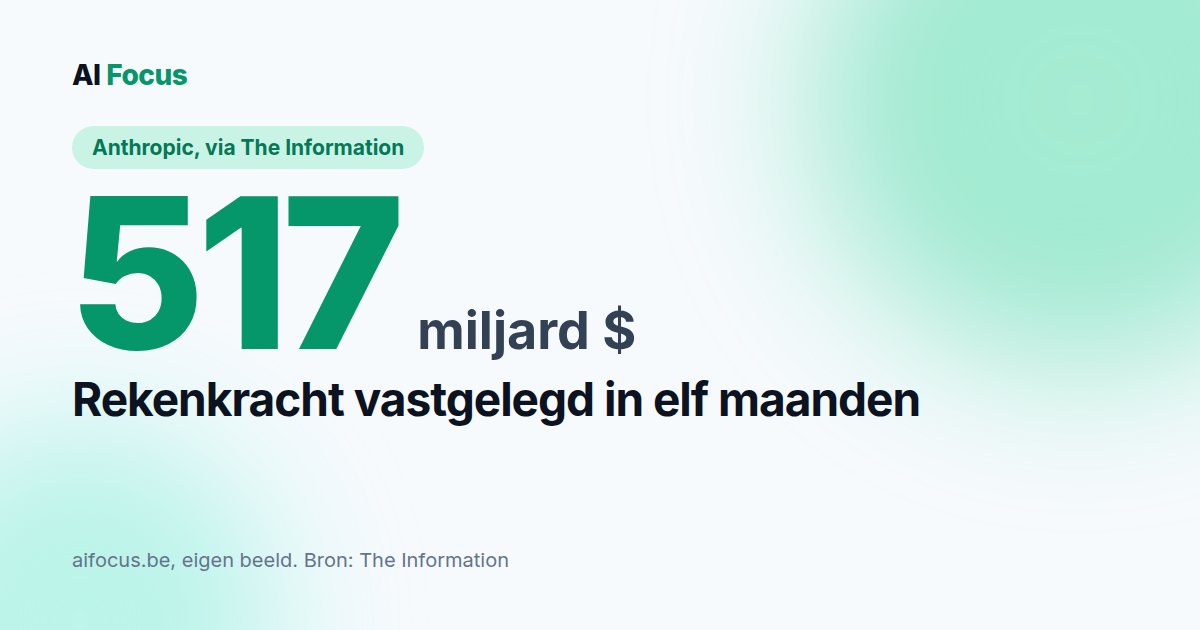
You can read this two ways. The first: genuine conviction. Pachocki’s essay is serious, alignment really has not been solved, recursive self-improvement really is scary, and this is not a fringe voice. In July 2026, Anthropic signed an open letter urging the federal government to slow AI development, with Pachocki himself as a signatory. But that sincere framing sits beside an awkward contrast: those same labs calling for slowdown just signed up for hundreds of billions in compute capacity.
The second reading is less charitable. A slowdown coordinated by the market leader freezes the race with the leader in front. It is a moat dressed as caution: whoever leads loses nothing in a universal pause, and followers cannot catch up. The tell is the antitrust question itself. You ask that only if your plan amounts to agreements between rivals.
And here it helps to pull Pachocki’s proposals apart. Mandatory frameworks, enforced by auditors and governments, put the referee outside the labs. There is little wrong with that. Labs agreeing to slow down together put the referee inside the cartel. That is the antitrust-sensitive part, and it happens to be the part OpenAI is reportedly seeking legal cover for.
Take the safety concerns seriously, then, because they probably are sincere. But “let us all slow down together”, from the mouth of the one in the lead, calls for an independent referee, not the word of the frontrunner. If you want to know how close OpenAI sits to the edge of the law, do not look at the essay but at the question it reportedly asked Congress. That you are seeking legal cover means you know you need it.