Anthropic Signs Half a Trillion in Compute Agreements
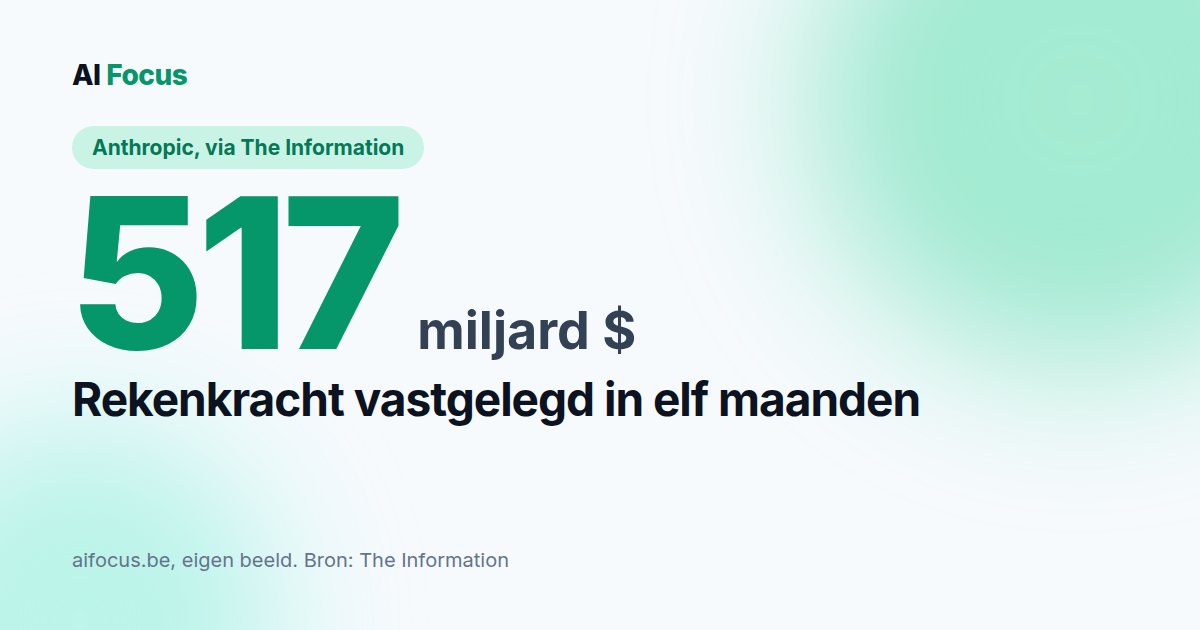
Up to $517 billion. That’s how much Anthropic, the company behind Claude, signed across compute-power contracts in the past eleven months: agreements with cloud providers and datacenter builders to lease the chips and servers on which AI models run. The Information reported this around September 6, 2026, behind a paywall; DataCenterDynamics and The Decoder picked up the details. Worth noting upfront, because it applies to every figure in this post: this is reporting from The Information; Anthropic itself has not confirmed anything.
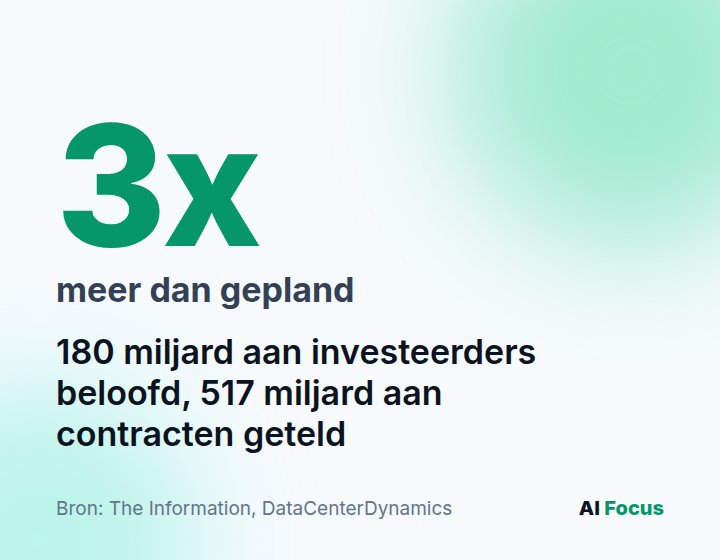
Half a trillion, accumulated since October 2025. How far that deviates from Anthropic’s own roadmap becomes clear when you look at what the company told its investors earlier: through 2029, it expected to spend around $180 billion on server rental. The contracts added up total nearly three times that figure. Even Anthropic itself did not foresee this pace when it gave investors an estimate.
Fourteen gigawatts, supplied by almost everyone
Behind the dollar amount sits raw power. According to the same reporting, Anthropic locked in at least 14.8 gigawatts of usable capacity, on top of the 1 to 2 gigawatts it already had. A gigawatt is the unit in which datacenter power is measured; 14.8 gigawatts is roughly equivalent to the power of ten large nuclear reactors running full-time for a single company. Google and AWS are by far the largest suppliers, together accounting for 11 gigawatts. Deals also exist with Microsoft, SpaceX, Lambda, nScale and Fluidstack.
| Figure from reporting | Value |
|---|---|
| Signed compute contracts since October 2025 | up to $517 billion |
| What Anthropic predicted to investors (server rental through 2029) | around $180 billion |
| Capacity being added | at least 14.8 gigawatts |
| Capacity already in place | 1 to 2 gigawatts |
| Google and AWS share of new capacity | 11 gigawatts combined |
| Comparison: OpenAI’s infrastructure plan through 2030 | around $750 billion |
The explanation The Information offers: demand for Claude Code and Cowork, the products with which Claude writes code and handles office tasks independently, grew faster than Anthropic had predicted. That aligns with what we saw in early September with Claude Fable 5.1 pricing: Anthropic made agents via the API far cheaper because that’s where the growth is, and agents consume compute power at a scale no chat window can match. Only OpenAI plans even bigger: its infrastructure plan runs to around $750 billion through 2030.
Early 2026, the same man sounded very different
Now the other half of the story. In early 2026, Anthropic CEO Dario Amodei said of his competitors that they “don’t really understand the risks they’re taking”, meaning in other words they don’t fully grasp what risks they’re assuming. That wasn’t a stray comment: Anthropic exists because its founders thought OpenAI was too reckless, and caution here is not a viewpoint but the brand itself.
Eleven months of signing later, the same company’s counter sits at half a trillion according to The Information. Last week we saw OpenAI publish acceleration figures and a cautionary essay in one morning; this is Anthropic’s version of the same split personality. The entire sector asks in words for caution and signs for acceleration in numbers. And those two don’t weigh equally. A warning is a press release: free, nonbinding, updatable tomorrow. A contract for hundreds of billions is a legal obligation. The brake is a press release, the accelerator is a contract.
Believe it, and you have to buy
Yet the charge of hypocrisy only half fits. Amodei has never said Anthropic itself would slow down; his point was always that this technology will come anyway, and it’s better built by those who take the risks seriously. If you truly believe that, you have to lock in capacity. Otherwise you leave the future to those less concerned about risks, and your rightness buys you nothing. Safety research is itself a major consumer: alignment experiments, tests to check whether a model does what its maker intends, run on the same expensive chips as everything else.
There’s another factor at play. Anthropic according to the same reporting filed a confidential IPO request with the U.S. Securities and Exchange Commission in June 2026, the first step toward going public. A company heading to the market would rather show investors a hockey-stick curve than a pause button, so don’t expect the appetite to quiet down anytime soon. But that same IPO will also be the test case for this story: in a prospectus, the official document used to sell shares to the public, “up to $517 billion according to sources” cannot stay vague. The actual commitments must be there in black and white.
Until then, treat that $517 billion as solid journalism, not confirmed fact. And judge AI labs the way you’d judge a bank: by the balance sheet, not the brochure. The warnings from Amodei and others may be genuine, but they don’t set direction. Direction is set in the contracts, and at every major lab they point the same way: harder.
Update September 9, 2026: what such a compute race actually produces became clear a day later: OpenAI claimed an AI solution to the Navier-Stokes millennium problem after an 88-hour sprint.