
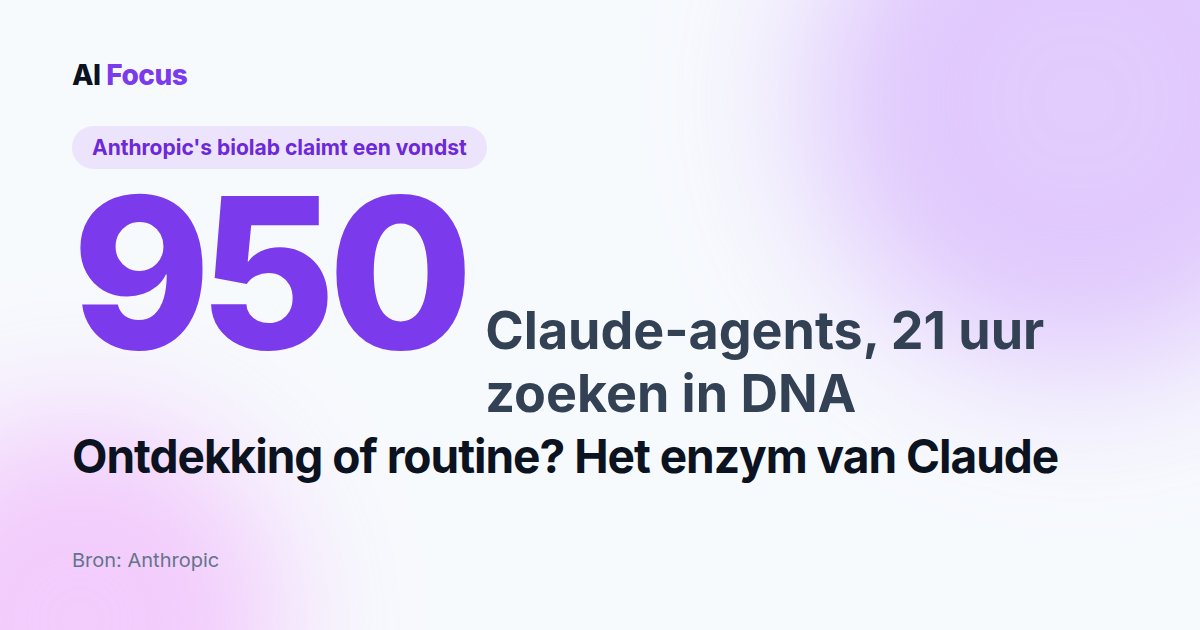
Claude finds new enzyme system, but what does it do?
An AI agent digging through a DNA database and suddenly getting audibly excited: “[The DNA next to the RT] is spectacular: I can see by eye a tandem repeat array … that’s a CRISPR-like … repeat array?!” That quote appears in “Claude discovers a novel enzyme system with CRISPR-like repeats”, the announcement Anthropic published on September 23, 2026, together with a scientific preprint. The message: a swarm of Claude agents found a previously unknown enzyme system on its own, in viruses that infect bacteria. The response from the CRISPR world came quickly and was far less festive. A researcher who trained under Nobel laureate Jennifer Doudna calls the work routine. Both camps have a point, and that is exactly why this story is more interesting than the headline suggests.
First, the biology: enzymes, RTs and CRISPR
An enzyme is a protein that carries out a chemical job in a cell: cutting something, joining things together, copying something. A reverse transcriptase, RT for short, is an enzyme with an unusual specialty. Normally, information in a cell flows from DNA to RNA, like a blueprint being copied onto a worksheet. An RT does the reverse: it writes RNA back into DNA. The best-known example is found in HIV, but RTs occur throughout nature, including in bacteria and in the viruses that attack bacteria, the bacteriophages.
And CRISPR? It started out as a bacterial defense system. In their DNA, bacteria keep a kind of photo album of past invaders: short snippets of viral DNA, each separated by the same repeated sequence. That row of repeats is called a CRISPR array. If the same invader comes back, the bacterium turns those memories into short pieces of RNA that guide a protein to the right target, and that protein then cuts the invader apart. Researchers later turned the system into a pair of genetic scissors for editing DNA with precision, which earned Jennifer Doudna and Emmanuelle Charpentier the 2020 Nobel Prize in Chemistry.
What the agents found
This spring, Anthropic set up its own life sciences research group, with a lab in the Bay Area. That lab only works at biosafety levels BSL-1 and BSL-2, without pathogens that infect humans, and all lab work is done by human scientists. Claude did the search work.
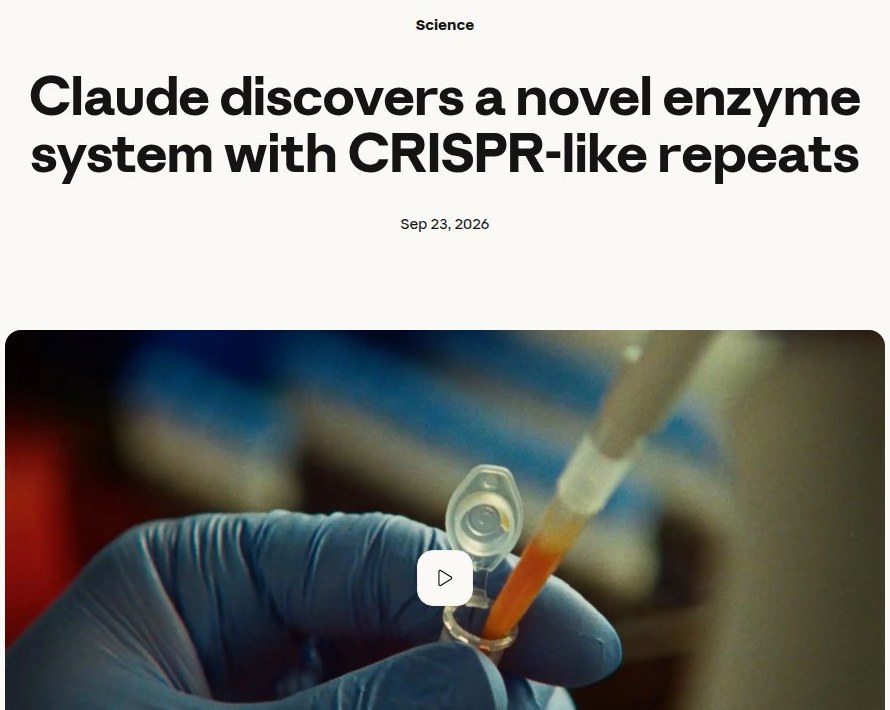
And that search work was substantial. About 950 Claude agents worked for 21 hours and used 210 million tokens between them. They combed through a large DNA sequence database, collected more than 200,000 RTs, picked out 3,500 new candidate systems and narrowed those down to the 20 most promising, each with a readable report. According to Anthropic, an analysis like this can take an expert weeks to months. Human input was limited to the starting prompt and the lab work afterwards. And with the current price war between the big labs, deploying a swarm of agents like this is only getting cheaper.
One of those agents came across an unusual RT family and noticed something next to it: a long string of regularly repeated DNA snippets, like in a CRISPR array. Hence the exclamation marks in the quote at the top. Anthropic named the system ART, for array-associated reverse transcriptases. It is found mainly in bacteriophages and consists of three parts: the RT itself, a neighboring partner gene that codes for a protein of unknown function, and that string of repeats.
An important detail: the RT on its own had already been described. What Claude was the first to notice, according to Anthropic, are the distinctive features around it: the array and that extra protein. The first lab experiments show that the array is read out as a series of short, separate RNAs. That resembles what happens in CRISPR. But what the system does with them, nobody knows. Anthropic says so plainly: “we don’t yet know its function”. The company does point out that this combination of features has so far only been seen together in a handful of other systems, and that all of those are programmable and cut, copy or paste DNA. That makes ART worth investigating, but it does not prove that it does the same thing. The research is ongoing.
Feng Zhang, one of the CRISPR pioneers (MIT and Broad Institute), read the preprint and responded positively: “This is an exciting example of how AI agents can contribute to biological discovery. The identification of RNA-repeat arrays associated with reverse transcriptases is genuinely intriguing and merits further investigation.” Note the choice of words: intriguing and worth investigating, not a breakthrough.
The criticism: this is just genome mining
Not everyone was impressed. Lucas Harrington, who did his PhD under Nobel laureate Jennifer Doudna and co-founded the CRISPR company Mammoth Biosciences, responded on X, The Decoder reports. His point: the method, genome mining, has been around for decades, and in his view similar systems have been known since 2008. Genome mining simply means systematically searching large amounts of DNA sequence data for interesting genes. The Decoder sums up his core point like this: “The hard part is figuring out what a system actually does, and Anthropic hasn’t shown that.” Mind you, that is The Decoder’s summary, not a verbatim quote from his post. According to the same source, Harrington also finds it unhelpful to present such early results as a major discovery. One caveat: Mammoth itself uses genome mining to look for CRISPR systems. So he knows the field, but he is also fishing in the same pond.
Notably, Anthropic does not even dispute his point about the method. The company itself writes that nearly all known RT families were found through genome mining. So the novelty lies not in the technique, but in who did the work and how fast.
| What Anthropic claims | What the critics say |
|---|---|
| Claude found a new enzyme system (ART) with CRISPR-like repeats | According to Harrington, similar systems have been known since 2008 |
| Claude was the first to notice the array and the extra protein | The method, genome mining, has been around for decades; Anthropic itself acknowledges that nearly all RT families were found this way |
| 950 agents did in 21 hours what takes an expert weeks to months | The hard part is working out the function, and that is still unknown |
| Humans only provided the starting prompt and did the lab work | Presenting early results as a major discovery is unhelpful |
Our take: faster searching, not yet understanding
Harrington is right on the points that matter for biology. Finding a system is the easy half; working out what it does is where scientists spend years. And “CRISPR-like” is a label that carries marketing weight. The word CRISPR conjures up genetic scissors, Nobel Prizes and cured diseases, while what we have here is something that resembles it structurally and whose function is completely unknown. That is not a lie, but it is a headline that promises more than the data can carry.
Still, “routine” misses the mark too. What is new is not the method but the scale and the autonomy. Hundreds of agents independently completing, in 21 hours, a search that takes an expert weeks to months, delivering 20 readable reports, and along the way spotting a structure that would also catch an experienced researcher’s eye, and being right about it. That is not a breakthrough in biology. It is a big leap in how fast the search work of biology can be done, although for now those figures come only from Anthropic itself. So the honest headline is not “AI discovers new CRISPR”, but “AI greatly speeds up the search work, understanding remains human work”.
It fits a pattern. Last week, Anthropic measured its own pace and claimed that Claude leads a quarter of its in-house AI research. Here you can see what that looks like outside the AI world itself: agents doing the legwork, humans holding the pipettes and having to draw the conclusions. And it echoes the Navier-Stokes dispute at OpenAI earlier this month: each time a lab launches an “AI discovers” story that is immediately contested, and each time the real verdict only comes later: there from the mathematicians checking the proof, here in the lab that has to work out the function.
One last thing readers should know. Anthropic says it is sharing this finding early “to demonstrate Claude’s capabilities”, in other words to show what Claude can do. That is honestly stated, and it also explains why research without a known function already gets a press release. This is a scientific finding that is also advertising. Nothing wrong with that, as long as you read it that way. The real test comes when someone in the lab figures out what ART actually does. Only then will we know whether Claude found a curiosity or something that will one day end up in a textbook.