
AI in Email Marketing: What ActiveCampaign Actually Does
This is the first episode of a new weekly format on AIFocus: we take one AI tool you can actually use as a business owner and put it under the microscope. Full disclosure upfront: this post contains one affiliate link, marked with an asterisk, and precisely because of that we follow strict house rules. We must name the downsides and alternatives; a post that reads like an ad does not go live. Today: ActiveCampaign, an email marketing and automation platform that calls its AI layer Active Intelligence, a copilot that designs, builds, and optimizes automations.
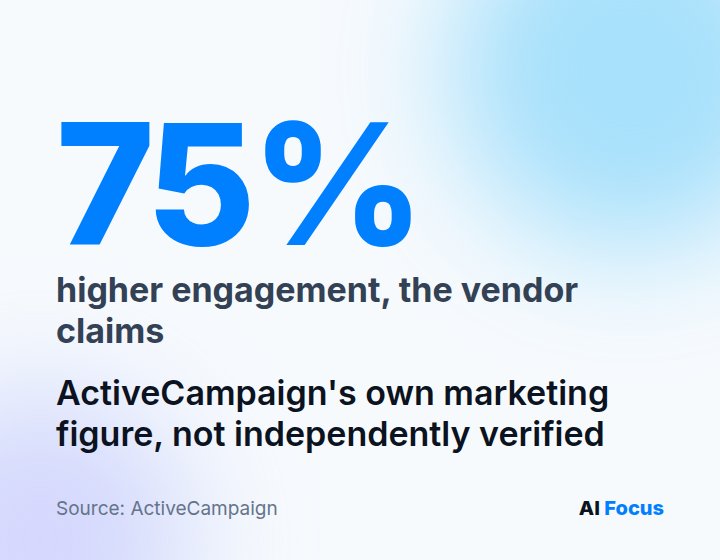
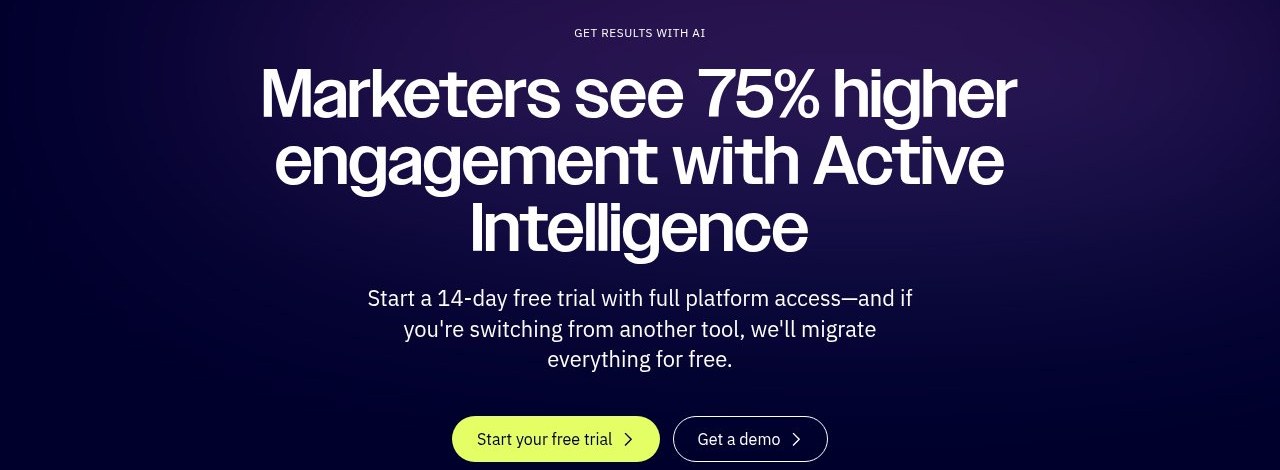
The big number ActiveCampaign leads with: “Marketers see 75% higher engagement with Active Intelligence”. Remember one thing about that figure: it comes from the vendor itself, with no independent verification. So we present it as a marketing claim, not as fact.
What the AI Does in Practice
The AI page of ActiveCampaign (as of September 21, 2026) lists a series of features with names like Scheduled Tasks, Proactive Campaigns, and Predictive Sending. Translated to what you actually get as a business owner, they fall into three buckets.
First, building. The AI Campaign Builder assembles a campaign based on what you ask, the AI Brand Kit pulls in your colors, fonts, and logo automatically so every email fits your brand right away, and AI Content Generation writes a first draft of your copy. This is the part you know from every AI tool: the promise of a faster first version.
Then, targeting. AI-Suggested Segments proposes contact groups that you would otherwise filter manually from your list, and Predictive Sending picks the send time per contact when that person opens email most often. This is the tedious, repetitive work where automation has historically earned its keep.
Finally, follow-up. Scheduled Tasks sends you insights autonomously to your inbox, Proactive Campaigns spot opportunities and build campaigns for them on their own, and Active Intelligence Insights answers reporting questions in plain English instead of sending you through dashboards. Here is where the copilot idea lives: not you operating the tool, but the tool coming to you with suggestions.
What It Costs, and Why Your Invoice Grows with Your List
Giving you an exact price is hard, and that is the first downside right there: the numbers do not sit static on the pricing page, because your price depends on how many contacts you have in your list, and for details the site points you to “Request Pricing”. The structure is clear though: four plans, with AI unevenly split among them.
| Plan | AI access | Limits |
|---|---|---|
| Starter | Active Intelligence “with limits” | max 5 actions per automation, limited segmentation, 1 user |
| Plus | limited AI | standard segmentation, 1 user (unlimited automation actions) |
| Pro | full Active Intelligence | 3 users, advanced segmentation |
| Enterprise | full AI plus dedicated team | 5 users, fully custom |
Your mail volume is tied to your contact limit: ten times your limit on Starter and Plus, up to fifteen times on Enterprise. ActiveCampaign keeps the entry barrier deliberately low: 14 days free to try, 30-day money-back guarantee, and free migration from your current tool.
The most important warning is not in the table: because price hangs on your contact count, a growing list is a growing bill. Email marketing that works makes itself steadily more expensive. That is not an ActiveCampaign trick alone, nearly the whole sector prices that way, but you have to factor it into your math. It is the same lesson from our post on what AI really costs a business: do not look at the entry fee, look at what it costs when it works.
Where It Breaks Down
The honest list, because that is what reviews are for. Full Active Intelligence lives only in Pro, one of the pricier plans; start on Starter “for the AI” and you get a limited version plus a ceiling of five actions per automation and one user. Pricing transparency could be better: the fact that exact amounts require a sales conversation makes comparing needlessly hard. And the 75 percent engagement boost stays vendor marketing until someone independently measures it.
Two points that do not make the pricing page. First, language. If you have the AI generate copy in Dutch, you will need to review it critically yourself, certainly for a Flemish audience. We have not tested this systematically, but anyone who has ever had AI generate Dutch copy knows the tone quickly turns Netherlands-Dutch or wooden; budget for proofreading. Second, your data. Email marketing with AI means your customer data sits in an American platform and gets processed there by AI functions. The GDPR homework, from processor agreements to what happens to that data, stays with you; our GDPR guide spells out what to watch for.
For Whom It Works, For Whom It Does Not
The profile that gets the most value here is the entrepreneur already running automations: flows, segments, follow-up emails after a purchase or a quote, losing time on them weekly. It is exactly on those tedious bits, building segments, picking send times, digging through reports, where the AI layer sits closest to real time savings. If you want to feel it yourself, you can try ActiveCampaign* for 14 days free, with the money-back guarantee as a safety net.
If you are only sending a monthly newsletter, though, you are buying a cockpit for a bicycle. Mailchimp and Brevo are the known alternatives and have their own AI features now; for those sending only newsletters, a simpler, cheaper tool is usually plenty. Compare on what you do today, not the longest feature list.
Our bottom line: AI in email marketing is not magic, it is time savings on the boring parts. That saving is real for teams already running flows and thin for those who do not. So never buy a plan for the AI promise alone. Start with what you do today by hand, work out what automating that is worth per month, and stack it against the invoice that grows with your list. If the math checks out, the free trial is the logical next step; if it does not, you save yourself the subscription.
This post contains affiliate links, marked with an asterisk. If you choose via such a link, we earn a small commission; you pay nothing extra.