
Claude Max claims 5x or 20x, lawsuit says no
On September 8, 2026, Anthropic faced an expanded class action lawsuit from its own subscribers. The charge: the company’s priciest Claude subscription tier, called Max, advertises 5x or 20x more usage than Pro, but according to the plaintiffs, that number doesn’t hold up. It’s a lawsuit, not a judgment, but the question it raises matters to anyone buying an AI subscription today: what are you actually paying for when you buy “more usage”?
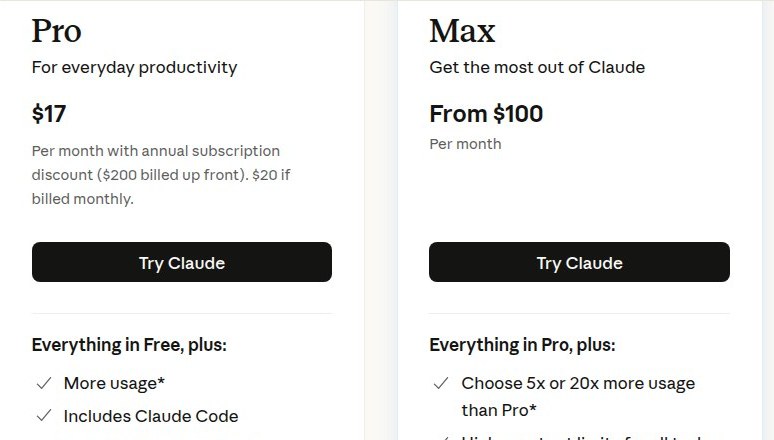
Anthropic makes it prominent on its pricing page. Max starts at $100 per month and lets you choose between 5x or 20x more usage than Pro, in Anthropic’s own words “Choose 5x or 20x more usage than Pro”, at $100 or $200 per month respectively. Pro sits below at $17 per month on an annual plan, or $20 if you pay monthly. Those two multipliers, 5x and 20x, are the entire sales pitch for the premium tier.
What the lawsuit alleges
The class action, filed at the U.S. District Court for the Northern District of California, expands on a federal complaint that individual subscriber Karl Kahn filed back in mid-June 2026. Kahn, a developer, is the lead plaintiff. The complaint in one sentence: Anthropic advertises a multiplier it doesn’t deliver in practice, and that’s false advertising.
According to the suit, the real limits fall far short of what the pricing page promises. On Max 5x, users would actually get roughly 3.5x Pro; on Max 20x, only about 6 to 8x Pro.
| Max tier | Price per month | Anthropic advertises | According to the lawsuit, in reality |
|---|---|---|---|
| Max 5x | $100 | 5x more than Pro | approximately 3.5x Pro |
| Max 20x | $200 | 20x more than Pro | approximately 6 to 8x Pro |
The plaintiffs seek damages exceeding 5 million dollars, not including costs, and want class status for all U.S. customers who bought a Max 5x or Max 20x subscription since the tier launched in April 2025. The grounds: deceptive advertising and unfair business practices, as reported by Engadget and The Verge.
The real cap is buried
To understand what the complaint rests on, you need to know how Claude measures usage. Your consumption resets every five hours, a session window: if you use a lot within that span, you hit your limit briefly, then reset and can continue. But on top of that window sits a weekly cap across all Claude models combined, which resets at a fixed time per account. That’s where the squeeze happens. According to the suit, the multipliers, those 5x and 20x figures, apply only to the five-hour window, not to that weekly cap. It’s that weekly cap that throttles heavy usage, such as long sessions in Claude Code, the programming tool that lets you invoke Claude directly in your codebase.
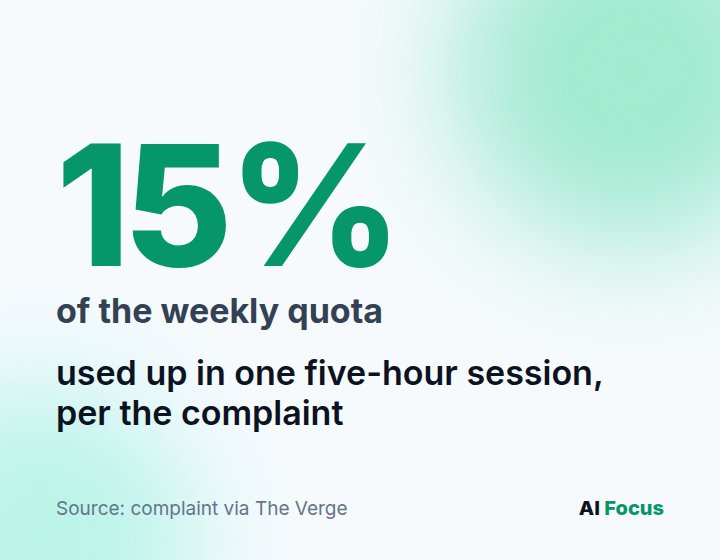
Kahn experienced it firsthand. He took a Max subscription for intensive development work. A single five-hour sprint, the complaint states, consumed roughly 15 percent of his entire weekly quota. After a full workday, you’d be at your limit for the week. He had to halt his work, ration his usage, or purchase additional usage.
There’s another detail the plaintiffs take issue with. The Max 20x tier displays a “Save 50%” badge. But according to the suit, that $200 tier delivers only about 1.7x the weekly Sonnet hours of the Max 5x tier at $100, far short of the 4x the jump from 5x to 20x would suggest. You’re paying double for less than double, with a discount badge on top. Whether that holds up is for the court to decide. It’s exactly the kind of math an ordinary customer can’t do.
The plaintiffs’ attorney, Monica Vaca, summed up the core problem to The Verge:
“This is hard for consumers, they don’t know what’s in the black box.”
That’s the question in a sentence. You’re buying an amount of “usage” you can’t see, can’t count, and only feel when you hit the wall. The multiplier on the pricing page is the only hard number you get, and according to the suit, that’s not the number that matters.
Ask about the weekly limit, not the multiplier
Whatever the court decides, this isn’t an isolated incident. It’s the same pattern we’ve seen repeatedly in recent weeks. With GPT-6 Astra, you suddenly got half as many messages for the same price, and OpenAI no longer accepts new customers for its Pro plan. What you think you’re buying, a model, a message count, a multiplier, isn’t what you get, because the real limit sits in the fine print: weekly caps, five-hour windows, limits across all models combined.
The counterargument deserves a hearing too. This is one side of the story. A complaint isn’t proof, and the plaintiffs’ numbers, those 3.5x figures, those 6 to 8x figures, those 1.7x claims, are their reading, not an established fact. Against the original complaint, Anthropic filed a motion to dismiss, arguing that all relevant details were available during purchase via hyperlinks. The company compared it to flipping a box over to read the back: the information was there. Beyond that, Anthropic has largely declined to comment. That defense isn’t weak, because anyone who truly digs into a product page often finds more than the headline promises.
And yet that’s precisely the lesson, regardless of the verdict. “Usage” has become an opaque unit in AI, and the bold multiplier on the pricing page tells you less about what you’ll get than the fine print about the weekly limit you have to hunt down yourself. If you’re considering an expensive AI subscription for serious work, the question that matters isn’t “how many times the starter plan”, but “what’s the weekly limit, and after how many hours of real work will I hit it”. Ask about the cap you’re going to run into, not the number on the box.