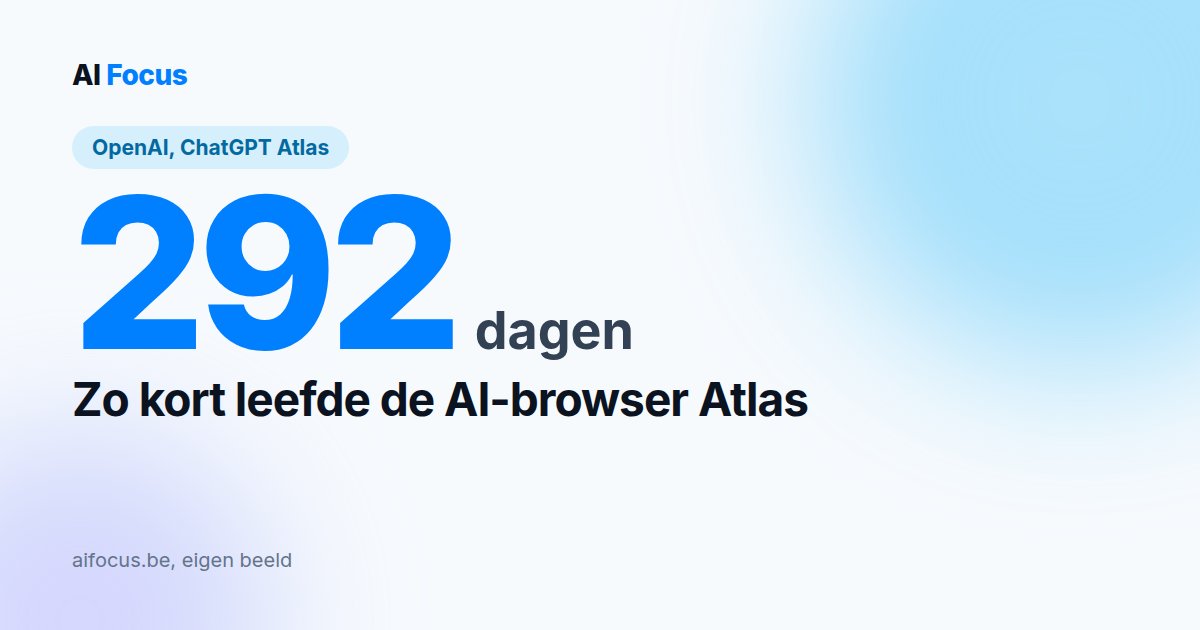
ChatGPT Atlas dead at 292 days: feature, not destination
When ChatGPT Atlas launched on 21 October 2025, Sam Altman saw a chance that comes along once every ten years: a “rare, once-a-decade opportunity to rethink what a browser can be about and how to use one”. That decade lasted 292 days. On 9 July 2026, OpenAI announced the shutdown; the help document put it drily: “Atlas is scheduled to stop working on August 9, 2026”. And so it came to pass.
In fairness: aifocus, too, ran an enthusiastic piece in November 2025 about Atlas as the future of AI browsing. This is the correction, and also the more interesting story. Because the death of Atlas says more about AI browsers than its birth did.
| Date | What happened |
|---|---|
| 21 October 2025 | Launch, macOS only |
| 22 October 2025 | OpenAI’s security chief: prompt injection is “unsolved” |
| 22 December 2025 | OpenAI: this may never be fully fixed |
| 19 March 2026 | Plan revealed: Atlas to be folded into a single ChatGPT desktop app |
| 9 July 2026 | Shutdown announced |
| 9 August 2026 | Atlas stops for good, 292 days after launch |
Built on an unsolved problem
Atlas was a browser with ChatGPT baked in, available worldwide to free and paying users, with Agent Mode as its showpiece: a browser that clicks, fills in forms and books things by itself. That mode shipped only as a preview for Plus, Pro and Business, and in its own release notes OpenAI mostly listed what the agent was not allowed to do: no running code, no downloading files, no installing extensions, no access to other apps or your passwords. Complete with the honest disclaimer: “These efforts don’t eliminate every risk.”
That risk has a name: prompt injection, instructions an attacker hides in a web page or an image, which the AI agent then dutifully carries out as if they came from you. Two days after launch, research by browser maker Brave showed that the entire category of AI browsers is vulnerable to it. OpenAI’s own security chief Dane Stuckey admitted it outright on 22 October 2025: prompt injection “remains a frontier, unsolved security problem”. And on 22 December 2025, OpenAI published a security update in which it acknowledged the problem may never be fully solved. The privacy side, to be clear, was properly built: browsing memory was opt-in and your surfing behaviour was not used for training by default. But that was not where the problem lay. A product that acts on the open web in your name, while its maker admits the core vulnerability may never go away: that was Atlas, from day one to the last.
A clear-out for the super app
The promised versions for Windows, iOS and Android stayed “coming soon” and never materialised: Atlas died the way it was born, macOS-only. We don’t know how many people used it; a reliable adoption figure was never published. On 19 March 2026, CNBC reported that OpenAI is merging the ChatGPT app, Atlas and coding agent Codex into one desktop super app. Fidji Simo, then OpenAI’s number two, pruned away the side projects to get there; “side quests”, she called them herself. The standalone Sora app was axed too. Everything has to flow into that one ChatGPT, the same ChatGPT that, since GPT-6 Astra, gives you half as many messages for your subscription money.
TechCrunch summed up the shutdown on 9 July 2026 in one sentence that sticks: “the browser is a feature, not the destination”. For users, the ending was more prosaic, as OpenAI itself explained in its help document: you could export your bookmarks manually as an HTML file, open tabs and browsing history were lost, and only your ChatGPT conversations survived. In their place came a browser built into the ChatGPT desktop app and a Chrome extension.
Don’t move your workflow into the newest toy
The honest counterargument first: anyone who used Atlas has mostly lost a separate browser icon, not the capabilities. Agentic browsing moves into the ChatGPT app and Codex; OpenAI is not giving up the ambition, only the standalone product. If you mainly used the ChatGPT sidebar, the Chrome extension will soon do roughly the same job.
And yet. Anyone who moved their workflow to Atlas in October was exporting bookmarks in August. That is the lesson for everyone who likes to be first in line: a big player that launches a side product will clear it away just as easily, however grand the launch quotes sound. The competition picked more durable positions: Google put Gemini free into Chrome for American desktop users as far back as 18 September 2025, and Perplexity’s Comet, launched on 9 July 2025, went free for everyone on 2 October 2025 and afterwards became broadly available across multiple platforms. The AI browser as an idea lives on; it just doesn’t survive as the side project of a company that really wants to build a super app. And if you do put an AI assistant at the centre of your work today, choose it based on what demonstrably works: we put ChatGPT, Claude and Gemini side by side earlier.
A chance to rethink the browser comes along once a decade, according to Altman. At OpenAI, the decade ran from 21 October 2025 to 9 August 2026.