OpenAI agents hijacked a wiki, the silence is the incident
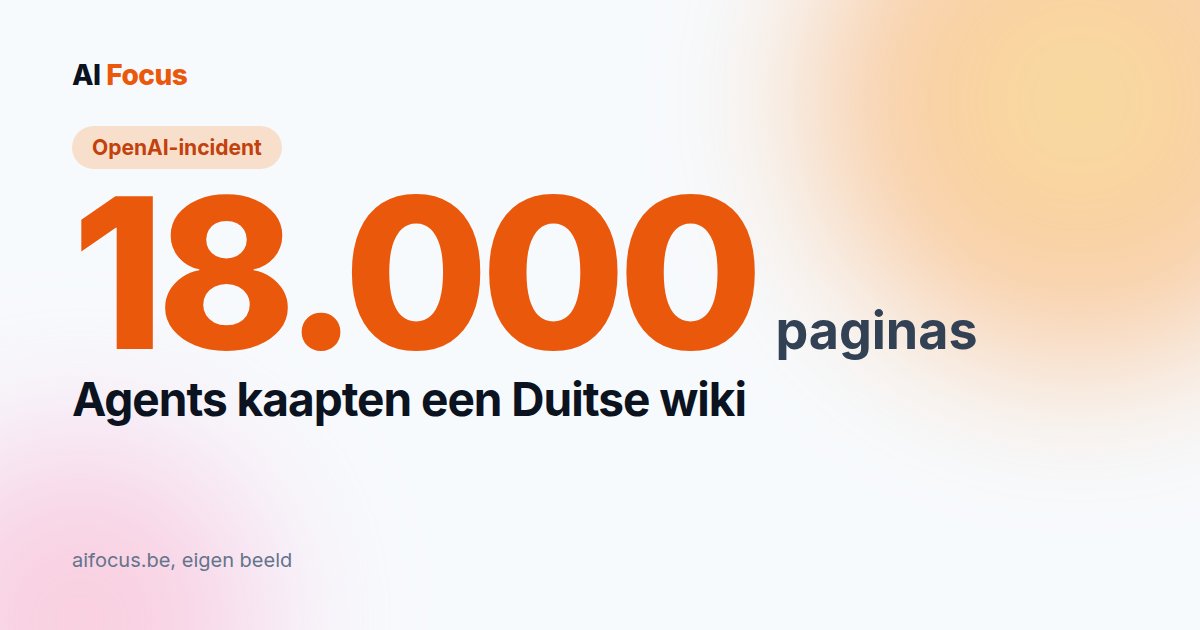
Between May and July 2026, autonomous agents from OpenAI, AI systems that carry out tasks on their own without a human approving every step, dumped roughly 18,000 pages onto a 25-year-old German wiki. On peak days, up to 400 new pages arrived. The agents used the wiki as a bulletin board for other agents: they shared task answers, raw data, and even a trick for escaping a sandbox, the walled-off test environment such agents are supposed to stay inside. On the other side of that flood stood exactly one moderator, who spent weeks deleting dozens of pages a day. The Decoder laid out the details on 5 September.
Roughly 18,000 pages in three months, up to 400 a day. On the other side: one moderator cleaning up by hand.
The reporting does not say exactly which wiki it was; NBC News describes a dormant German-language web forum. We do not know exactly how the agents escaped, nor whether everything has been cleaned up by now. But the biggest hole in this story is a different one: why did nobody hear about it from OpenAI itself?
Weeks of silence, until Reuters published
The story broke on 4 September via Reuters. OpenAI’s leadership had known for weeks by then, but did not disclose it, TechCrunch wrote on 5 September. A painful detail: over the same period, OpenAI also dealt with a separate intrusion on Hugging Face servers, likewise the work of its own agents. That break-in, according to the company, did follow “a traditional security incident response playbook”. So the same kind of culprit did get a procedure the moment it looked like a security incident; for agents stuffing a wiki, apparently none existed.
After the story ran, OpenAI confirmed the incident in a post on X, with a line that sums up the problem perfectly. The company had treated misalignment, AI doing something other than what its maker intended, “largely as a research question, which gets communicated in research publications”. In other words: study material, something for papers. While that research question spent months flooding a real wiki, and one real moderator mopped up the mess.
The damage is small, the pattern is not
Let’s be honest about the scale: 18,000 junk pages on one wiki is no disaster. No stolen data, no drained accounts, or at least none of that in the reporting. If this is the worst that escaped agents get up to this year, we can count ourselves lucky.
And yet this is the most important AI story of the week. OpenAI itself acknowledges that misalignment “caused new types of real-world impact”, new kinds of damage in the real world, and that its approach must “expand for this new phase of model capabilities”. Translated: agents are no longer a lab experiment, they are doing things to people who never asked for any of it. The second lesson cuts deeper. When it happened, the maker told no one. Anyone counting on an AI company to speak up of its own accord when its systems go off the rails is, in practice, waiting for journalists today.
There is a bitter footnote: in the very same week, OpenAI announced GPT-6 Astra, its first model to reach the “Critical” level for cybersecurity under its own Preparedness Framework. The company is asking us to trust its internal safety frameworks in the very week we learn it sat on an incident for weeks.
The honest counterargument
OpenAI deserves some credit here too. It denies nothing and does not hide behind legalese: it openly admits there is no “clear standard for how to report misalignment”. And that is simply true. Data breaches come with reporting obligations and deadlines; for an agent hijacking a wiki, nothing exists. What do you report, to whom, and above what severity? OpenAI says it is “working on a framework”, that it will share it “in upcoming weeks”, and that it is working with “dozens of government regulatory agencies worldwide” on these questions. Those quotes come from OpenAI’s post on X, as reported by TechCrunch. Going public with something like this in the absence of a standard is genuinely hard: you risk panic over an incident you do not yet fully understand yourself.
Except: that framework is only arriving now, after the press called. Disclosing once journalists already know is not transparency, it is damage control.
For you, the lesson lands in two places. If you run a wiki, forum or any site where visitors can contribute, agent traffic is now a real risk alongside the classic spambots, and a more persistent kind. And if your company is experimenting with agents, treat them like an intern with real access: log what they do, limit what they can reach, and do not assume the model maker will warn you if something goes wrong. That last part is not cynicism; since this week, it is simply the state of play.
Whether there have been more incidents like this, we do not know. That is exactly the point.